


Introduction: The magic of a celestial show on an Arctic night
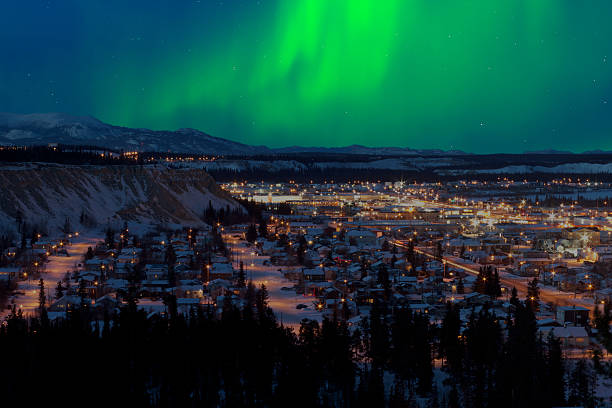
The aurora borealis, also known as the Aurora Borealis, represent one of the most spectacular natural phenomena on our planet. Dancing in the night sky, the multi-colored streaks of light have mesmerized observers for thousands of years, inspiring legends, myths and scientific research. The Yukon Territory in Canada is one of the best places in the world to observe this amazing phenomenon.
The Yukon, located in northwestern Canada, is a vast area with low population density, minimal light pollution, and an ideal geographic location in an auroral activity zone. This unique region offers observers the opportunity to see some of the brightest, most colorful and dynamic auroras on the planet.
In this article, we’ll take an in-depth look at what the auroras are, why the Yukon is the ideal place to see them, which locations in the region are considered the best for this purpose, what time of year and day to plan your trip, and what conditions are necessary for a successful “northern lights hunt.” Whether you are an experienced astrophotographer, an adventurer, or simply a lover of natural wonders, the Yukon offers an unforgettable experience of encountering the magic of the polar sky.
The scientific explanation of the aurora borealis
Before traveling to the Yukon to observe the northern lights, it’s helpful to understand the nature of this fascinating phenomenon. The auroras result from a complex interaction between solar activity and the Earth’s magnetic field.
The mechanism of occurrence
It all starts on the Sun, where powerful explosions known as solar flares and coronal mass ejections occur. These events release huge streams of charged particles (mostly electrons and protons) that rush into outer space, forming the “solar wind.” When these particles reach the Earth, they interact with its magnetic field.
The Earth’s magnetic field acts as a shield, deflecting most of these particles. However, near the magnetic poles, the field is weaker, and charged particles can penetrate the upper atmosphere – at about 80 to 640 kilometers altitude. Here they collide with atoms and molecules of gases, mainly oxygen and nitrogen, causing them to become excited.
The excited atoms quickly return to their normal state, releasing energy in the form of light. It is this light that we see as the auroras. The different colors of the auroras are associated with different gases and the altitude at which the interaction occurs:
- Green and yellow color (the most common) occurs when interacting with oxygen atoms at altitudes of about 100-300 km
- Red color appears when interacting with oxygen at high altitudes (over 300 km)
- Violet, blue, and pink colors occur in collisions with nitrogen
Solar activity and forecasting
The intensity and frequency of auroras are directly related to solar activity, which follows an 11-year cycle. During periods of maximum solar activity, auroras become more frequent, more intense and can be observed at lower latitudes.
Modern technology makes it possible to predict geomagnetic storms and thus the likelihood of auroras. There are specialized services and apps, such as NOAA’s Aurora Forecast or the local Aurora Alert Yukon app, that help plan observations.
Why the Yukon is the perfect place to observe the aurora borealis
The Yukon area has a number of characteristics that make it one of the best places on the planet to observe the aurora borealis:
1. Geographic location in the auroral zone
The Yukon is located in what is known as the “auroral oval,” a ring-shaped zone around the Earth’s magnetic pole where the phenomenon of auroras is most frequent and intense. Most of the Yukon is located at latitudes between 60° and 70° north latitude, which is optimal for regular aurora observation.
2. Minimal light pollution
The Yukon is one of the most sparsely populated areas in Canada, with a population density of less than 0.1 people per square kilometer. This means minimal light pollution, which could make it difficult to observe the night sky. Travel a few kilometers away from the few populated areas and you can find yourself in near perfect darkness.
3. Favorable climatic conditions
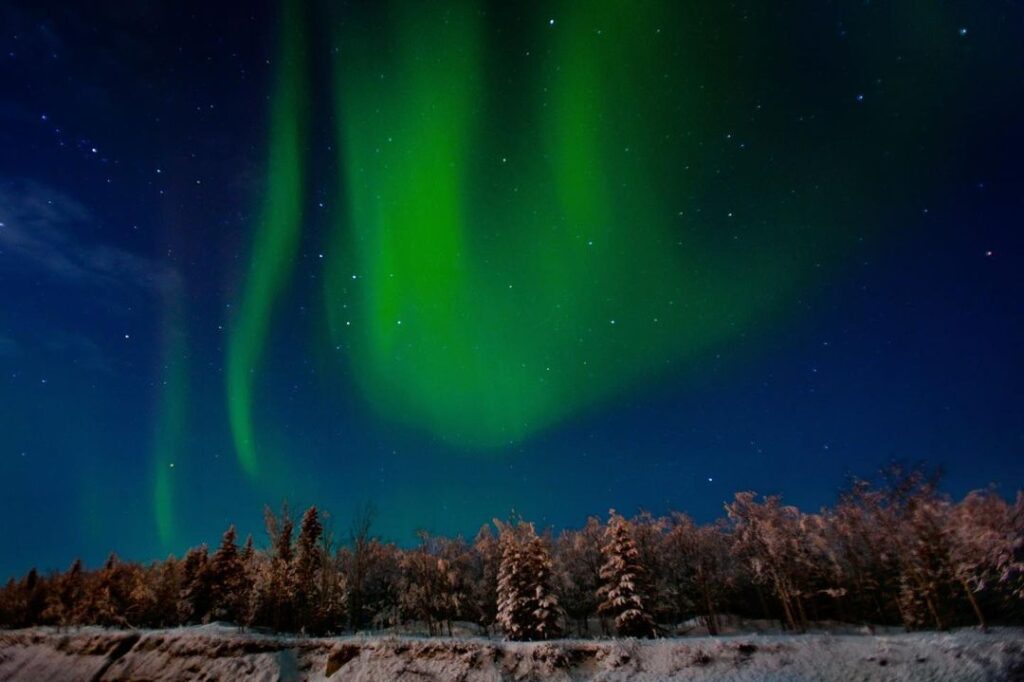
Despite harsh winter temperatures, the Yukon is known for its relatively dry climate and plenty of clear nights, especially during the winter. The territory’s capital, Whitehorse, boasts more than 2,000 hours of sunshine per year, indicating the prevalence of cloudless weather – a key factor for successful aurora borealis sightings.
4. Extended observing season
In the Yukon, the aurora borealis can be observed for most of the year, from late August through early April. This is a much longer period than in many other places famous for the northern lights.
5. Developed infrastructure
Despite its remoteness, the Yukon offers a well-developed tourist infrastructure geared specifically for aurora borealis viewing. From specialized tours and professional guides to comfortable hotels and glamping sites designed specifically for observing the night sky, you’ll find it all.
Best places to see the aurora borealis in the Yukon
While the aurora borealis can be seen from almost anywhere in the Yukon on a favorable night, some locations offer particularly spectacular viewing conditions. Here’s a selection of the most popular locations:
1. Whitehorse and surrounding areas
The capital of the Yukon, Whitehorse, is a natural starting point for most travelers. Although city lights create some light pollution, even within the city limits on particularly active nights it is possible to see the bright aurora borealis.
For optimal viewing conditions, it is recommended to travel outside the city limits. Just 20-30 minutes from the city center, ideal conditions can be found:
- Schwatka Lake (Schwatka Lake) is a popular spot among locals, located just 5 km from the city center. The lake offers open space with minimal light pollution and beautiful reflections of the auroras on the water surface.
- Grey Mountain is an elevated hill east of the city, offering panoramic views of the night sky. The mountain offers great views to all sides of the horizon, increasing the chances of spotting the aurora regardless of its exact location.
- TheWhitehorse Fish Ladder is a unique place where you can combine polar aurora sightings with an interesting piece of architecture in winter.
2. Northern Lights Resort & Spa
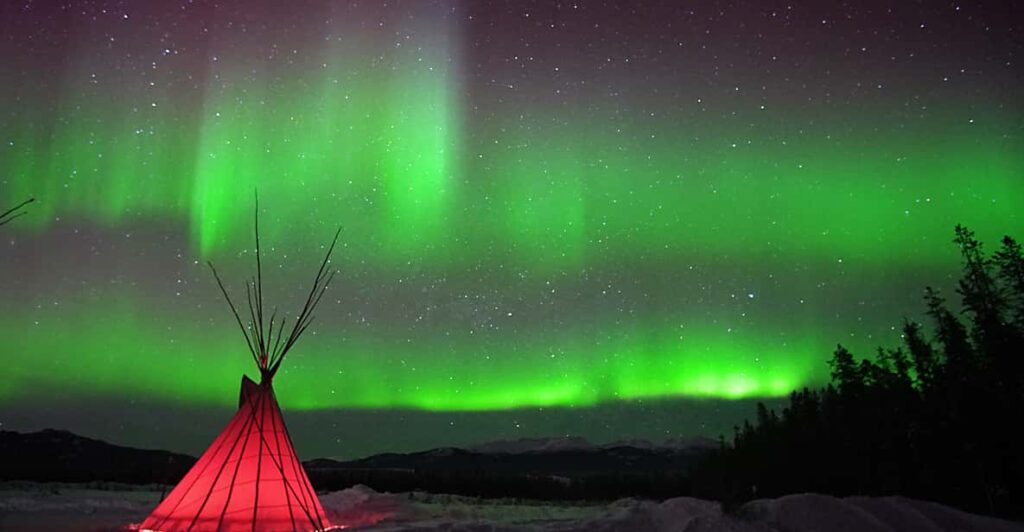
Located 20 minutes south of Whitehorse, this specialized resort offers the perfect setting for observing the aurora borealis. The resort is set away from city lights, amidst majestic peaks and dense forests of spruce and Yukon black pine.
Guests can enjoy the view of the auroras directly from their glass-walled chalets, specially designed to observe the celestial displays. There are also special outdoor areas for observation and photography.
3. Kluane National Park
Located about 150 kilometers west of Whitehorse, Kluane National Park and Reserve is one of the most spectacular natural landscapes in the Yukon. It is home to Mount Logan, Canada’s highest peak (5,959 meters) and one of the world’s largest accumulations of ice fields outside of the polar regions.
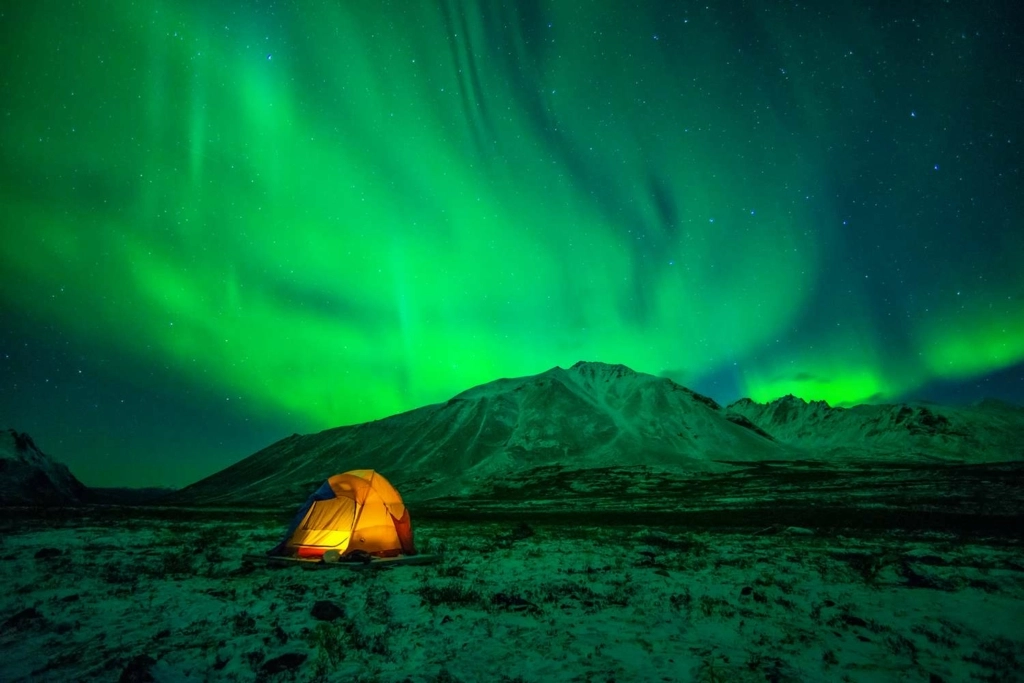
In winter, the park becomes an ideal place to see the aurora borealis, especially around Kathleen Lake. The dramatic scenery makes for a stunning foreground for aurora borealis photos.
4. Dawson City
The historic town of Dawson City, once the center of the famous Klondike Gold Rush, is located further north of Whitehorse and offers even more favorable conditions for observing the aurorae. Less light pollution and a more northerly location increase the chances of seeing a spectacular show.
The best places to watch include:
- Midnight Dome observation deck – an elevated area with panoramic views of the city and the Yukon River Valley
- TheKlondike Trail, a road that runs along the Yukon River, with many convenient places to stop and watch
5. Tombstone Territorial Park
Located about 110 kilometers northeast of Dawson City, Tombstone Park is known for its sharp, tombstone-like mountain peaks (hence the name). The park’s remote location guarantees a complete absence of light pollution, and the dramatic mountain silhouettes create the perfect foreground for photographing the aurora borealis.
6. Lake Emerald
This is a small scenic lake located along the Klondike Highway, about 175 km south of Whitehorse. Known for its bright turquoise water in the summer, the lake freezes over in the winter and makes a great setting for observing the aurora borealis. The reflection of the auroras on the ice creates some truly magical visual effects.
When is the best time to see the aurora borealis in the Yukon
Choosing the right time is critical to successful aurora borealis viewing. In the Yukon, there are several key factors that determine the best time to “aurora hunt”.
Seasonality
In the Yukon, the aurora borealis can be observed for most of the year, but not all of the year is equally favorable for this purpose:
Thebest period is from mid-August to mid-April
This is due to two main factors:
- Thelength of the dark time of day – the longer the night, the more opportunities to see the auroras. During the summer months, the Yukon experiences the phenomenon of “white nights” when the sun sets only briefly or not at all.
- Weather Conditions – Winter in the Yukon usually has clearer skies, which is critical for observing.
The most optimal months are considered to be:
- September-October: still relatively mild with adequate night length
- February-March: maximum solar activity often occurs during the spring months, with nights still long enough and temperatures not as extreme as in mid-winter
Time of day
Polar lights can occur at any time of night, but there are periods when they are more likely to occur:
Peak hours: between 10:00 p.m. and 2:00 a.m. at night
This time coincides with the period when the Earth’s magnetosphere in the Yukon region is most optimally oriented relative to the solar wind. However, bright auroras can be observed at other times of the night, so patience is an important quality for the observer.
Solar activity
The intensity of the auroras is directly related to solar activity. The solar activity cycle is approximately 11 years, with alternating periods of maximum and minimum. In 2025, solar activity is on the rise, approaching its maximum, making this and the coming years particularly favorable for observing bright auroras.
Phases of the Moon
Bright moonlight can make it difficult to observe fainter auroras due to natural light pollution. Ideal times for observations are the nights around the new moon, when the Moon does not illuminate the sky. However, during strong geomagnetic storms, the auroras can be so bright that they are clearly visible even during a full moon.
How to prepare for observing the aurora borealis
Successfully observing the auroras in the Yukon requires some preparation, especially given the region’s harsh winter conditions.
Clothing and gear
Winters in the Yukon are extremely cold, with temperatures often dropping to -30°C and below. Proper outfitting is crucial:
- Multi-layered clothing – the “bow” principle is key: a base layer of thermal underwear, a medium insulating layer (fleece or down) and an outer windproof and waterproof layer
- Extremely warm footwear – special winter boots designed for temperatures down to -50°C
- Face protection – balaclava or mask to protect against frostbite
- Quality gloves or mittens – preferably with the ability to use touch screen devices if you plan to take photos
- Thermos with hot drinks – helps to keep you warm during long observing sessions
- Insulated seat – prevents heat loss when sitting on snow or ice
- Headlamp with red light – does not interfere with eye adaptation to darkness
Photo equipment
For those who plan to photograph the aurora borealis:
- Camera with manual settings – DSLR or mirrorless with long exposure capability
- A wide-angle lens with great aperture – f/2.8 or brighter is ideal
- Sturdy tripod – absolutely essential for long shutter speeds
- Spare batteries – cold greatly reduces battery life
- Remote control or timer – to minimize camera shake
- Hand warmers and battery warmers – to help keep your equipment working properly
Choosing a location
Even within the regions mentioned above, it is worth considering a specific location for observations:
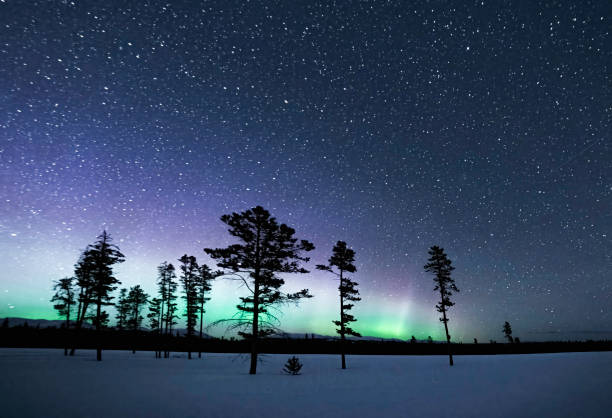
- Open spaces – look for locations with a good view of the northern horizon, such as frozen lakes, fields or uplands
- Minimal light pollution – go at least 10-20 km away from cities and towns
- Safety – choose locations with cellular coverage or let someone know your plans
- Foreground for photos – interesting landscape elements (trees, mountains, lakes) can greatly enhance the composition ofyour shots
Polar Lights Forecasting
Using specialized forecasting tools increases the chances of seeing bright auroras:
- Specialized apps – Aurora Forecast, My Aurora Forecast, Northern Light Alert
- Local resources – Aurora Alert Yukon Facebook group where locals share real-time information about current activity
- Professional Forecasts – NOAA’s Space Weather Prediction Center (SWPC) provides scientific forecasts of geomagnetic activity
Organized tours vs independent observations
There are two main approaches to observing the aurora borealis in the Yukon: organized tours and independent expeditions. Each has its own advantages and disadvantages.
Organized tours
Advantages:
- Guides with experience and knowledge of the best locations
- Provision of transportation suitable for winter conditions
- Often include photographic equipment and photography tips
- Warm rooms or shelters to keep warm between sightings
- Safety in unfamiliar and potentially dangerous winter conditions
Disadvantages:
- Higher cost
- Limited flexibility in time and locations
- Need to share the experience with other tourists
Popular tours in the Yukon:
- Aurora Borealis & Northern Lights Tours Yukon – one of the oldest companies specializing in polar lights tours in Whitehorse
- Northern Tales Travel Services – Offers a variety of tours including multi-day expeditions and specialized photography tours
- Epic North Tour Experiences – offers combination tours with winter activities in addition to aurora borealis sightings
Self-guided observations
Benefits:
- Complete freedom in choosing the time and location
- The ability to observe several nights in a row at no additional cost
- Secluded experience alone with nature
- Cost-effective for longer stays
Disadvantages:
- Need to research forecasts and locations on your own
- Need to rent a suitable vehicle
- Increased risks without an experienced guide
- Need for your own equipment
Tips for independent observers:
- Rent a vehicle – be sure to choose a four-wheel drive vehicle with winter tires
- Fuel – always keep your tank at least half full, gas stations can be sparse
- Communications – buy a local SIM card or satellite phone for emergencies in remote areas
- Maps – download offline maps, GPS signal may be unstable
- Emergency kit – carry blankets, a supply of water, food, matches and a basic first aid kit
Unique lodging options for observing the aurora borealis
The Yukon offers a number of specialized lodging options designed specifically to optimize the aurora borealis experience:
1. Northern Lights Resort & Spa
Located in a scenic valley 20 minutes from Whitehorse, this resort offers specialty Aurora Glass Chalets with floor-to-ceiling panoramic windows facing north. Guests can watch the aurora borealis right from their warm bed. The resort also offers spa services, a sauna and outdoor hot tubs, making waiting for the auroras more comfortable.
2. Inn on the Lake
This cozy hotel on the shores of Marsh Lake, about 35 km from Whitehorse, offers the perfect combination of comfort and wilderness. There is a special heated observation deck on the shores of the frozen lake, offering panoramic views of the northern sky. Guests can also take advantage of the “northern lights alarm clock” – staff will wake you up if the aurora borealis starts during the night.
3. Glamping and yurts
Throughout the Yukon, you can find several companies offering accommodation in comfortable yurts or glamping sites located away from the cities. These options offer a unique wilderness experience, but with a certain level of comfort. Many of them have transparent domes or large windows for sky watching.
4. Remote Lodges
For a more immersive experience, you can consider staying at remote lodges accessible only by snowmobile or dog sled. Places like Blachford Lake Lodge or Arctic Range Adventures offer an authentic Canadian wilderness experience with comfortable accommodations and professional guides.
Author Information

I’m a journalist specializing in urban issues and city politics in the Vancouver region, which I’ve covered since 1994, and I also have a strong focus on the iGaming industry. In this endlessly changing city, I cover a broad range of issues: from drug policy, bike lanes, billion-dollar development projects, homelessness, and garbage debates, to the rapidly evolving world of online gaming, including regulatory landscapes, technological advancements, and market trends. I write frequently for the Globe and Mail’s B.C. section and Report on Business. From 2008 to 2015, I had a regular column in Vancouver magazine, “Urban Fix,” which apparently resonated with readers so much that it earned me a few regional and national awards.