

In the heart of Canada’s majestic Rocky Mountains lies the breathtakingly beautiful Banff National Park, the country’s oldest nature reserve and a UNESCO World Heritage Site. For more than 135 years, this unique piece of nature has attracted millions of tourists from around the world with its turquoise lakes, majestic mountain peaks, lush coniferous forests and abundant wildlife.
History of creation: from hot springs to national pride
The history of Banff Park dates back to 1883, when workers building the Canadian Pacific Railway accidentally discovered hot springs at the foot of Mount Sulphur. This discovery started a long dispute between the discoverers and those who wanted to utilize the springs for commercial purposes.
In 1885, Canadian Prime Minister John A. Macdonald made the momentous decision to designate a 26 km² area around the hot springs as a protected area called the Banff Hot Springs Reserve. It was the first protected area in Canada and the third in the world (after Yellowstone in the USA and the Royal National Park in Australia).
In 1887, the area was expanded to 674 km² and renamed Rocky Mountain Park, and in 1911, after several boundary changes, the park area was set at 6641 km², remaining within these limits until today. Since 1930, with the passage of the National Parks Act, the area has been given its present name, Banff National Park.
The Canadian Pacific Railway played a crucial role in the development of the park, building a network of hotels, including the famous Banff Springs Hotel, and launching a massive advertising campaign to attract tourists. In the early 20th century, roads were built, including using war internees and Great Depression-era public works participants.
In 1984, Banff National Park, along with neighboring parks, was designated a UNESCO World Heritage Site as part of the Canadian Rocky Mountain Parks complex.
Geographical features: the majesty of mountains and glaciers
Banff Park is located in the province of Alberta, 110-180 kilometers west of the city of Calgary. It occupies the eastern slope of the main Rocky Mountain Range and a significant portion of the Front Range. The landscape of the park is formed by glaciers that left behind U-shaped valleys, numerous lakes and impressive mountain peaks.
The territory of the park is characterized by significant differences in altitude – from 1400 m to more than 3600 m above sea level. The highest point of the park is Mount Columbia (3491 m), and the famous peaks of Mount Rundle and Castle Mountain have become Banff’s calling cards.
The park is home to the headwaters of many important rivers, including the Bow River, which crosses the park from west to east, forming a picturesque valley and the famous Bow Falls. The park is also home to numerous glaciers and ice fields – the largest of which are located on the Waputik Range, the Wapta Icefield and the Columbia Icefield at the junction with neighboring Jasper National Park.
Banff’s climate is of the alpine type with fairly mild winters due to warm chinook winds. Average January temperatures range from -15 to -5 °C, while summer temperatures usually stay between 7 and 22 °C. Annual precipitation is approximately 472 mm, and the Lake Louise area receives up to 290 cm of snow in winter.
An alarming trend in recent decades is the accelerated melting of the park’s glaciers due to global warming, jeopardizing not only the natural ecosystems but also the long-term tourist appeal of the region.
Flora and fauna: a wealth of biodiversity
Vegetation
The vegetation of Banff Park varies with altitude. About 53% of the area is covered by the subalpine belt with coniferous forests dominated by twisted pine, Engelmann spruce, Scots fir and some deciduous trees such as aspen, willow and maple. Another 27% of the area is alpine with alpine meadows and glaciers. The tree line in the park runs at an altitude of about 2,300 meters.
The park is home to rare and endangered plant species, including some endemic species – found only here. The flora is especially rich around the thermal springs, where unique ecosystems with unusual species of mosses and algae have formed.
Animal life
Banff is a real paradise for lovers of watching wild animals. Fifty-six species of mammals, including large carnivores and herbivores, have been recorded within the park:
- Bears: grizzly and black bear (baribal)
- Predators: puma, wolf, lynx, wolverine
- Ungulates: wapiti (Canadian caribou), black-tailed and white-tailed deer, elk, snow goat, bighorn sheep (mountain sheep)
- Small mammals: marmots, chipmunks, pika and others.
The park is characterized by a low species composition of reptiles and amphibians due to the harsh mountain climate – there are only 1 species of toads, 3 species of frogs, 1 species of salamanders and 2 species of snakes.
The world of birds in Banff is rich and diverse – no less than 280 species of birds have been registered, including white-headed eagle, golden eagle, osprey, various species of falcons, white partridge, loons, herons and many others.
Of particular concern to ecologists are endangered species such as the Banff Springs snail, the woodland caribou and the Banff spruce grouse (the latter, unfortunately, is already considered extinct).
Attractions and natural wonders
Glacial lakes
The gems of Banff National Park are undoubtedly its stunning lakes with crystal clear water of turquoise blue hues:
- Lake Louise is the park’s most famous and photographed lake. It is named in honor of Princess Louise Caroline of Alberta, daughter of Queen Victoria. Surrounded by mountain peaks and glaciers, the lake is known for its bright turquoise water and the Fairmont Chateau Lake Louise hotel on the shore. Canoeing is available during the summer months, and in the winter, an ice skating rink is set up on the lake’s ice. Lake Louise
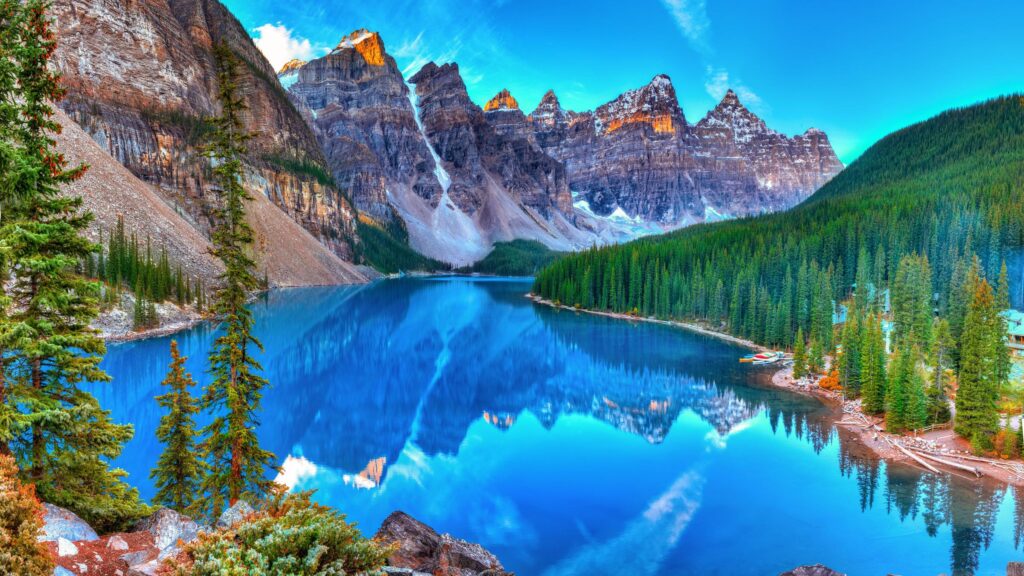
- Moraine Lake is the park’s second most famous lake, located in the Valley of Ten Peaks. Its sky blue water, surrounded by majestic mountains, creates one of Canada’s most recognizable panoramas and has even been featured on Canadian $20 bills. Moraine Lake
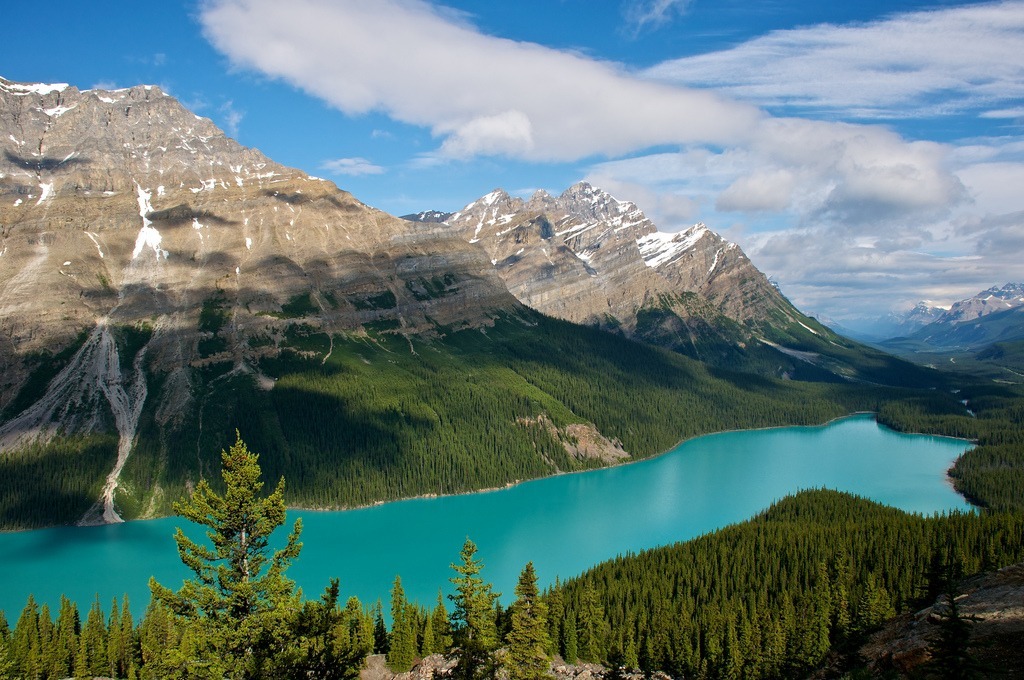
- Peyto Lake – Notable for its unusual shape, resembling a wolf or fox head, and exceptionally bright turquoise water.
- Vermilion Lakes – a chain of three lakes where the oldest evidence of human activity in the region, dating back some 10,300 years, has been found.

Hot springs and canyons
- Banff Upper Hot Springs are thermal springs with mineral water that reaches temperatures of up to 47°C. There is a public pool where you can swim in the healing water with a view of the mountains.
- Cave and Basin National Historic Site – This is where the first hot springs were discovered, which led to the creation of the park. Today, it is a museum that tells the story of the park’s history and natural values.
- Johnston Canyon is a scenic canyon with a trail along a rushing stream that leads to several waterfalls. In winter, the waterfalls turn into fantastic ice sculptures.
Mountains and glaciers
- Sulphur Mountain – famous for its Banff Gondola cable car, which takes tourists up to a height of 2281 meters, offering panoramic views of the Bow River Valley and the city of Banff.
- Columbia Icefield is one of the largest glaciers in the Rocky Mountains of North America, partially located within Banff Park. A particularly popular attraction is Ice Explorer – a ride on special all-terrain vehicles on the surface of the Athabasca Glacier.
Tourism and recreation: the best routes and activities
Hiking trails
Banff National Park offers more than 1,600 kilometers of marked hiking trails of varying difficulty:
- The Plain of Six Glaciers route is one of the most popular trails (about 14 km), starting at Lake Louise and leading to a tea house overlooking six majestic glaciers.
- Lake Agnes Tea House Trail – A relatively easy 7-kilometer trail through dense forest to high mountain Lake Agnes, where a historic tea house has operated since 1905.
- Cory Pass Loop Trail – a challenging 13km route with an elevation gain of over 900m, offering spectacular views of the Bow Valley.
- Hoodoos Trail – an easy route with minimal elevation gain leading to unusual rock formations known as ‘hoodoos’ (stone pillars formed by erosion).
Winter activities
Banff is a recognized center for winter sports in Canada. There are three major ski resorts located within the park:
- Sunshine Village, Canada’s highest altitude resort with a ski season from November through May.
- Lake Louise Mountain Resort is one of the largest ski resorts in North America with trails for skiers of all skill levels.
- Mount Norquay is a small but technically challenging resort with excellent slopes for advanced skiers, located just 10 minutes from the town of Banff.
In addition to skiing, the park offers snowshoeing, cross-country skiing, ice skating on frozen lakes and ice climbing on frozen waterfalls in winter.
Best time to visit
Each season in Banff has its own charm:
- Summer (June-August) is the peak tourist season with comfortable temperatures for hiking, kayaking and other outdoor activities. All trails and attractions are open during this time, including Lake Moraine (the road to which is closed in winter due to avalanche danger).
- Fall (September-October) is a great time for photographers, when the aspen groves turn golden colors and the number of tourists greatly diminishes.
- Winter (November-March) is the season for lovers of winter sports and snow-covered landscapes. Many summer attractions are inaccessible, but new activities open up.
- Spring (April-May) is the transitional season when the snow begins to melt in the valleys but still covers the highlands. The park is less crowded with tourists and accommodation prices are more affordable.
Environmental and conservation concerns
As Banff has grown in popularity, it has faced serious environmental challenges. Millions of visitors each year put significant strain on the park’s fragile ecosystems. Major problems include:
- Disruption of natural wildlife migration due to heavy traffic on the Trans-Canada Highway that crosses the park.
- Changes in animal behavior due to human contact and habituation to food waste.
- Accelerated melting of glaciers due to global climate change.
- Excessive pressure on popular tourist sites, especially Lakes Louise and Moraine during peak season.
In the mid-1990s, Parks Canada initiated a study of the ecological condition of the park, which led to the adoption of new strategies to preserve its natural integrity:
- Constructing special wildlife crossings across the Trans-Canada Highway.
- Restricting the construction of new infrastructure.
- Introducing quotas for the most popular attractions.
- Environmental education programs for visitors.
These measures help find a balance between tourism development and preserving Banff’s unique nature for future generations.
Practical information for travelers
- Entrance Fee: A permit (day, group or annual) must be purchased to visit the park. The cost of a day permit is about $10 CAD for an adult. There is also an annual Discovery Pass system that is available at all national parks in Canada.
- How to get there: The nearest international airport is in Calgary, from where Banff can be reached by rented car (about 1.5 hours via the Trans-Canada Highway) or by bus (regular flights of several companies).
- Accommodations: There are lodging options in and around the park to suit all tastes and budgets, from the luxurious historic Fairmont Banff Springs and Fairmont Chateau Lake Louise hotels to budget hotels, hostels and campgrounds. During high season, it is recommended to book several months in advance.
- Safety: It is important to remember that Banff is a wilderness area. Visitors are advised to keep their distance from wild animals, keep food in special containers, do not feed animals, follow rangers’ instructions and be prepared for rapid changes in mountain weather.
Banff National Park is a real pearl in the crown of Canada’s natural treasures, impressing with its grandiose landscapes, rich biodiversity and developed tourist infrastructure. For more than a century, this amazing wilderness has been delighting visitors from all over the world, offering a unique experience at any time of year.
The story of Banff is also the story of the development of the conservation idea in North America, the balance between making natural beauty accessible to people and preserving its pristine purity. Thanks to the careful efforts of Canadian conservationists and rangers, this oldest national park in Canada retains its grandeur and beauty, opening up the world to every visitor.
Author Information

I’m a journalist specializing in urban issues and city politics in the Vancouver region, which I’ve covered since 1994, and I also have a strong focus on the iGaming industry. In this endlessly changing city, I cover a broad range of issues: from drug policy, bike lanes, billion-dollar development projects, homelessness, and garbage debates, to the rapidly evolving world of online gaming, including regulatory landscapes, technological advancements, and market trends. I write frequently for the Globe and Mail’s B.C. section and Report on Business. From 2008 to 2015, I had a regular column in Vancouver magazine, “Urban Fix,” which apparently resonated with readers so much that it earned me a few regional and national awards.