

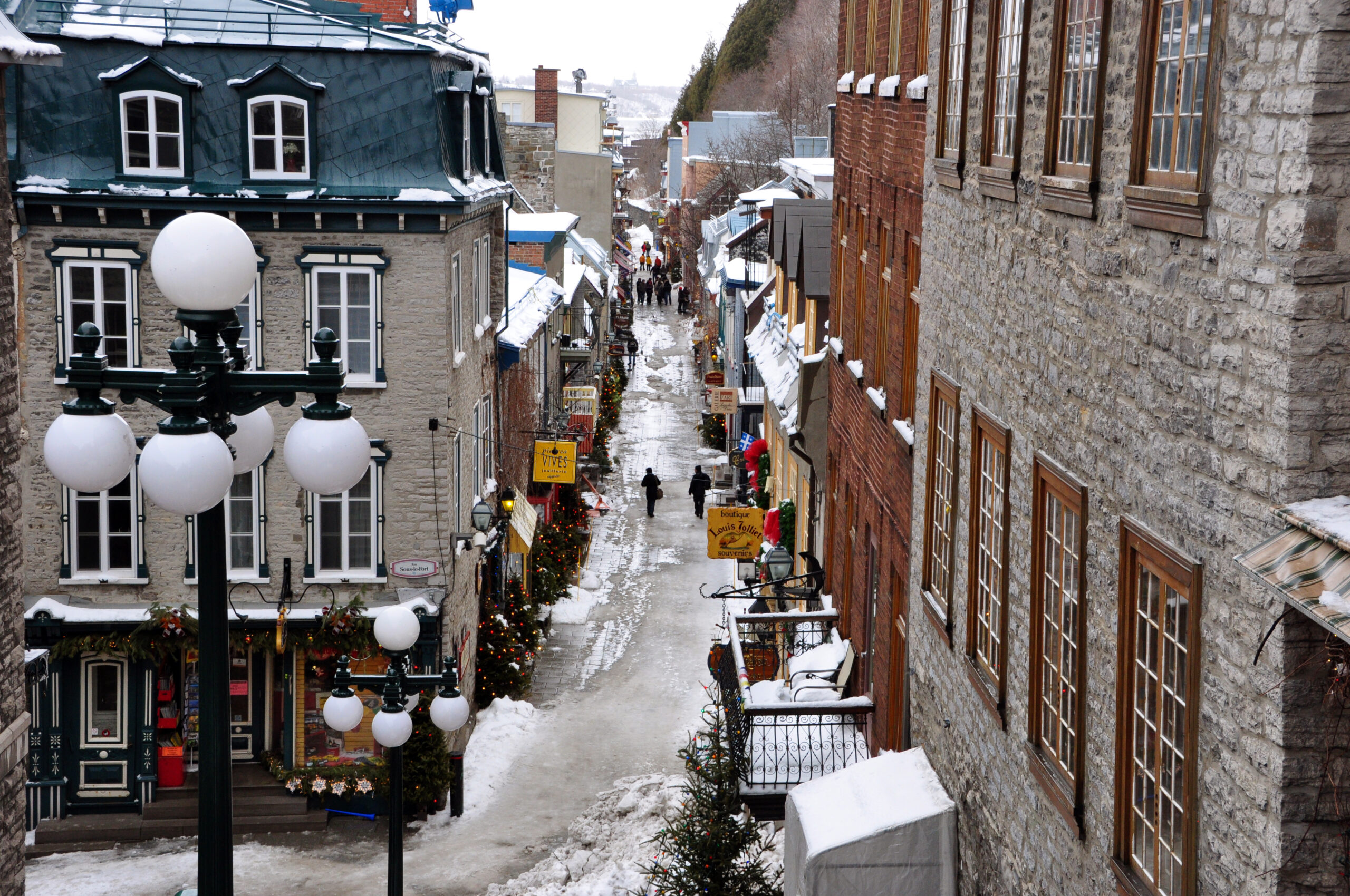
Among North American cities, there is a place that transports the traveler through time and space to eighteenth-century France. This is Old Quebec (Vieux-Québec), the historic center of Quebec City, the only surviving fortified city north of Mexico and a living testament to the European colonial heritage in the Americas. A UNESCO World Heritage Site, this unique architectural and historical complex attracts millions of tourists from around the world each year.
Cradle of New France
The history of Old Quebec begins when, in 1608, French explorer and diplomat Samuel de Champlain chose this site to build Chateau Saint-Louis, the future seat of government of New France. The name of the city comes from the word “Quebec”, which in the language of the Algonquin Indians means “where the river narrows”. Indeed, Quebec is located on a rocky promontory where the St. Lawrence River narrows significantly, which provided a strategic advantage in defending the territory.
From its founding, Quebec became the political, military and administrative center of the French possessions in North America. While traders and artisans settled in the Lower Town, government officials and priests settled in the Upper Town.
The first settlers
In 1617, a family of the first voluntary civilian settlers from France arrived in the fort. They were pharmacist Louis Hébert and his wife Marie Rollet and their three children, of whom two daughters, Anne and Guillemette, became the first French Quebec brides. Guilhemette Couillard later became the first French woman to give birth to French-Canadian children, beginning the indigenous population of French Canada.
Religion played an important role in shaping Quebec society. on May 6, 1627, Cardinal Richelieu issued an edict that forbade Protestants from settling in Quebec. He feared that Protestants would collaborate with Anglo-Americans from the rapidly developing British colonies. This decision kept Quebec from the religious conflicts that plagued neighboring Acadia, where a civil war broke out between Franco-Protestant and Franco-Catholic settlers in 1635.
Periods of British occupation
The history of Old Quebec was not a cloudless one. on July 19, 1629, English pirate David Kirk captured ships carrying provisions from France and forced Champlain to capitulate under threat of starvation. The period of the first British occupation (1629-1632) came. However, by the Treaty of Saint-Germain of March 29, 1632, the British withdrew from Old Quebec, returning it to French rule for the next 127 years. During this period of relative peace and prosperity, there was a renewed influx of French colonists.
By 1665, the town’s population was already about 550 people in 70 dwellings. A quarter of the inhabitants were members of religious orders: secular priests, Jesuits, and Ursulines, who ran the local hospital Hôtel-Dieu.
At the end of French rule in 1758, Old Quebec was a contrasting sight. Forests, villages, fields and pastures surrounded the urban fortress with a population of 8,000-9,000 (by comparison, Montreal’s population at the time was only about 5,000). Despite its status as the capital, Quebec remained a small colonial city closely connected to the countryside.
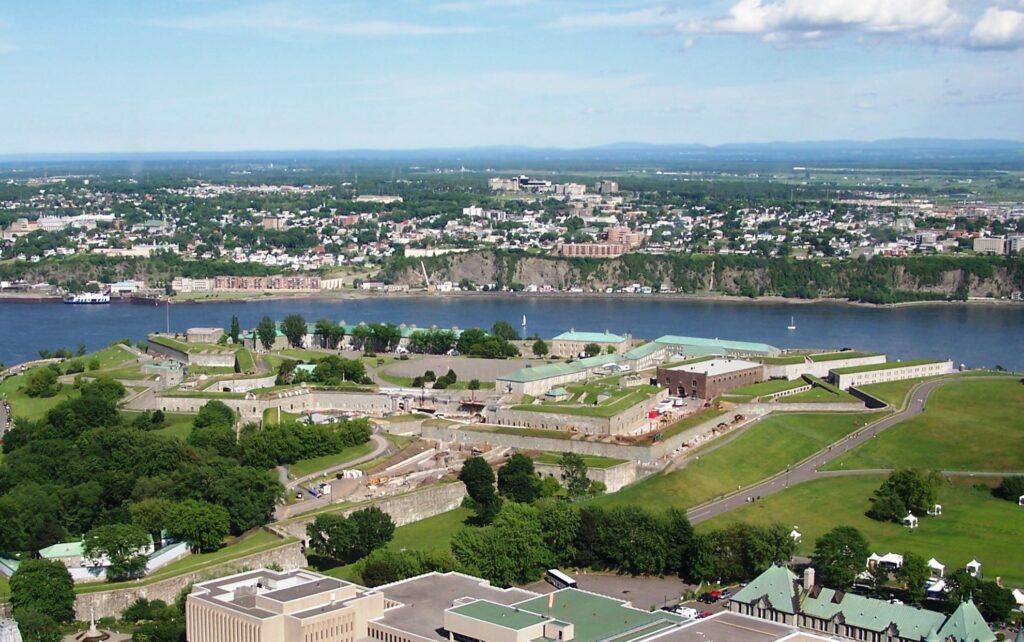
on September 18, 1759, 5 days after the French army’s defeat of Anglo-American forces at the Battle of Quebec, the city capitulated and was occupied by the British administration. An attempted French counterattack in 1760 was unsuccessful, and the Treaty of Paris in 1763 placed Quebec, as well as all of New France, under British administration.
Architecture and appearance of Old Quebec City
The only fortified city wall in North America
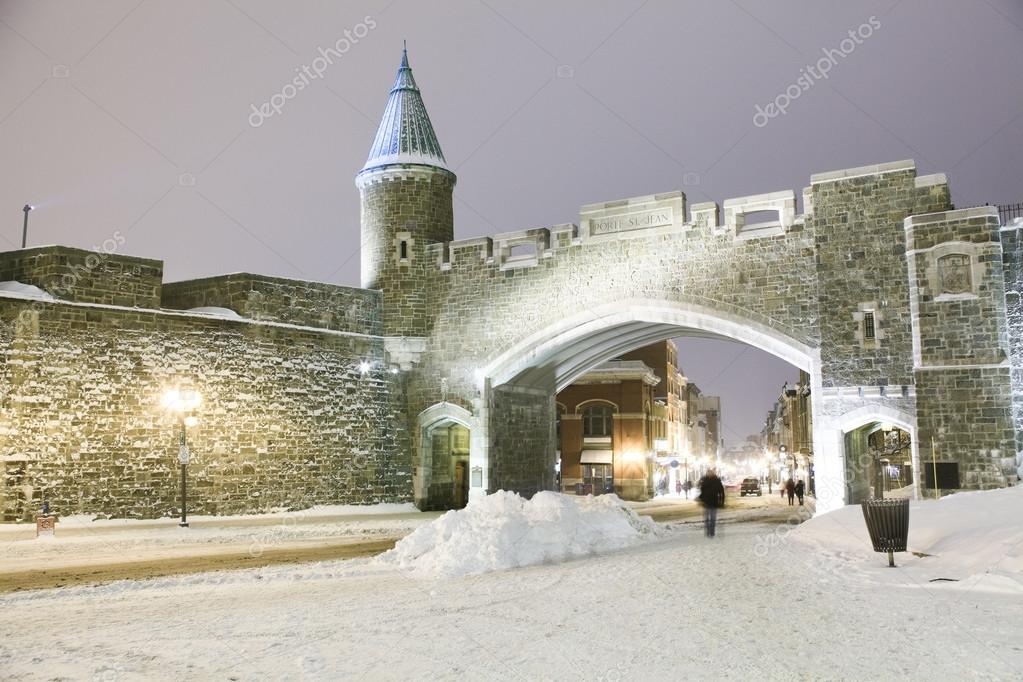
Old Quebec is a unique historical ensemble surrounded by about 4.6 kilometers of stone walls. It is the only city in North America that has preserved its ramparts with numerous bastions, gates and defenses.
The history of Quebec’s fortifications dates back to 1690, when the first temporary belt of fortifications was built at the request of the Count of Frontenac. The attack by Admiral Phipps and his New England fleet caused the city to be truly afraid of a European-style siege. From 1693, new fortifications were built according to the plans of Josue Boisbertelot de Beaucourt to replace the old temporary structures.
Between 1700 and 1720 the city becomes a huge construction site, but in 1721 the metropolis refuses to finish the Quebec defensive works, considering them less important than those in Montreal and Louibourg. It was not until 1745, after the surrender of Louibourg, that the governor of Beauharnois authorized the construction of a belt of fortifications entirely of stone.
The fortress as it exists today was completed during the Anglo-American War of 1812. The star-shaped fortifications were built between 1820 and 1831 under the direction of British Lieutenant Colonel and Royal Engineer Elias Walker Durnford and incorporate a section of the 1745 French defense wall.
In the late 19th century, many Quebecers favored the demolition of the military fortifications because they hindered the city’s development. However, Governor Dufferin was able to stop the destruction and even restored the parts of the walls that had been damaged. Thanks to his intervention, the city retained its historic appearance, which allowed it to be inscribed as a UNESCO World Heritage Site in 1985.
Upper and Lower Town: the two faces of Old Quebec City
Old Quebec is divided into two parts: the Haute-Ville (Upper Town) and the Basse-Ville (Lower Town). These two areas have different historical and architectural character.
The Upper Town is located on a cliff about 100 meters high and is surrounded by fortress walls. The main administrative buildings, religious buildings and iconic landmarks are concentrated here. In the Upper Town you can see the Quebec Fortress (Citadelle de Québec), the famous Chateau-Frontenac Hotel, the Quebec Parliament, Place d’Armes and much more.
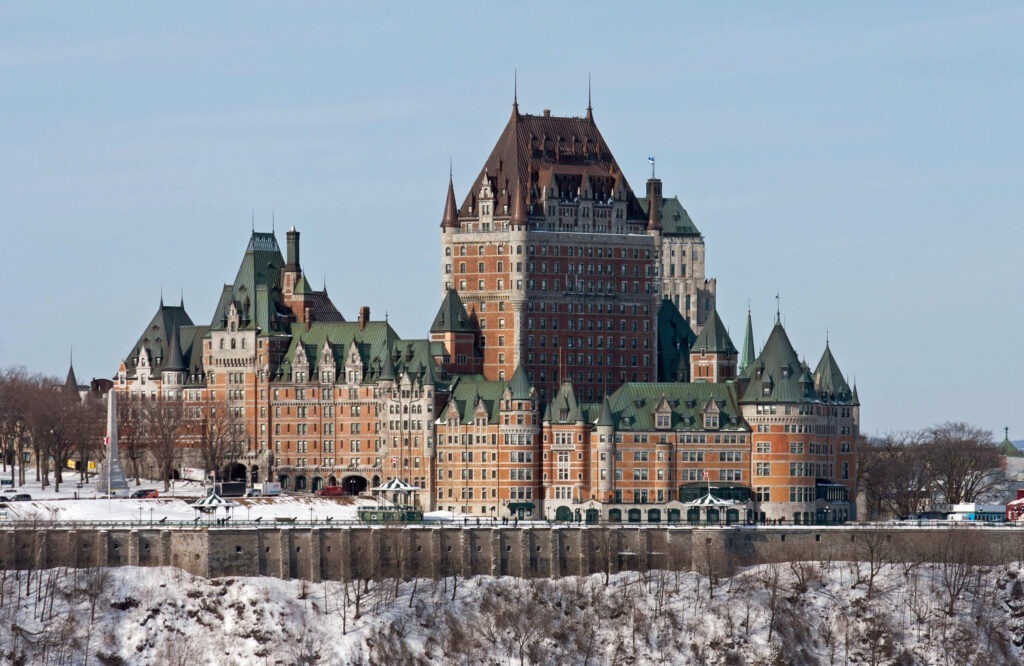
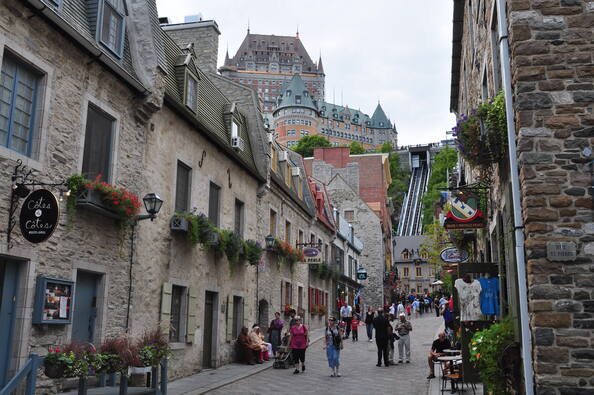
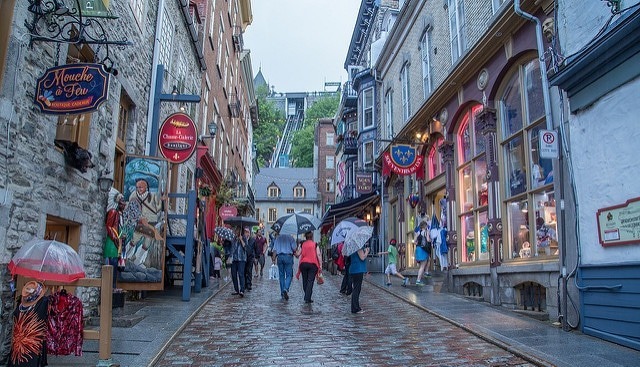
The Lower Town, located at the foot of the cliff, is a quaint weave of narrow streets, old buildings and squares. It is the former trade and craft center of colonial Quebec. It is home to attractions such as Place Royale, Notre-Dame-de-Victoire Church, Petit-Champlain Street and the Old Port waterfront.
The Upper and Lower Town are connected by a funicular, as well as the Staircase of the Breaking of the Neck (Escalier Casse-Cou), a steep stone staircase with many steps.
Old Quebec’s architectural styles
The architecture of Old Quebec is dominated by 19th century buildings, but some buildings date back to the 17th and 18th centuries. Here you can see different architectural styles: French colonial, British colonial, neo-gothic, boz-ar and others.
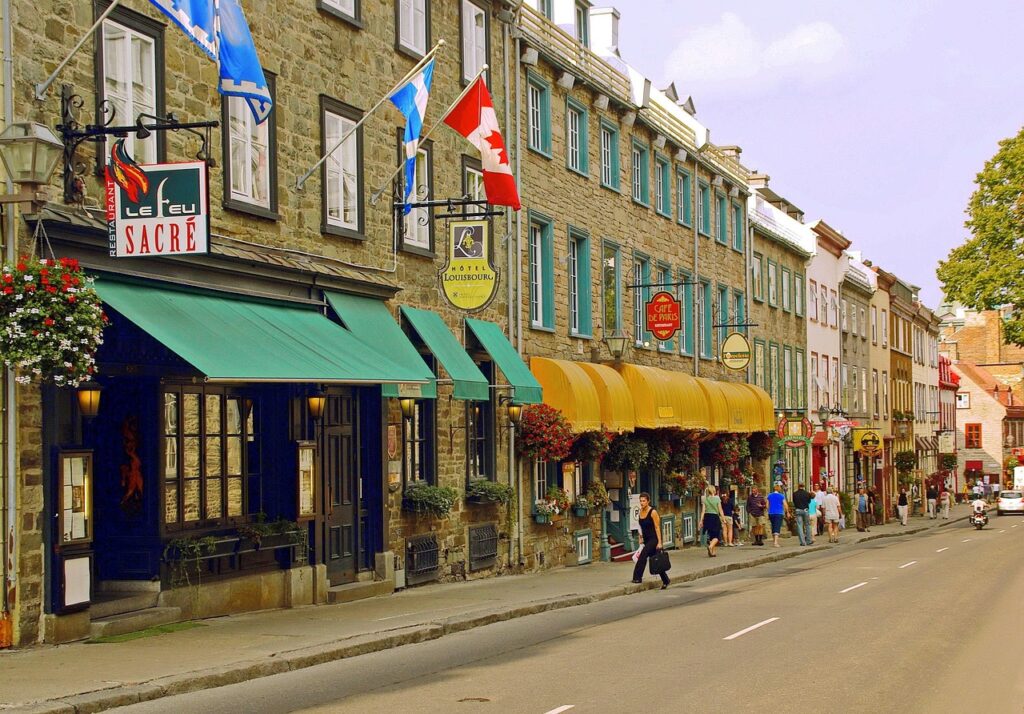
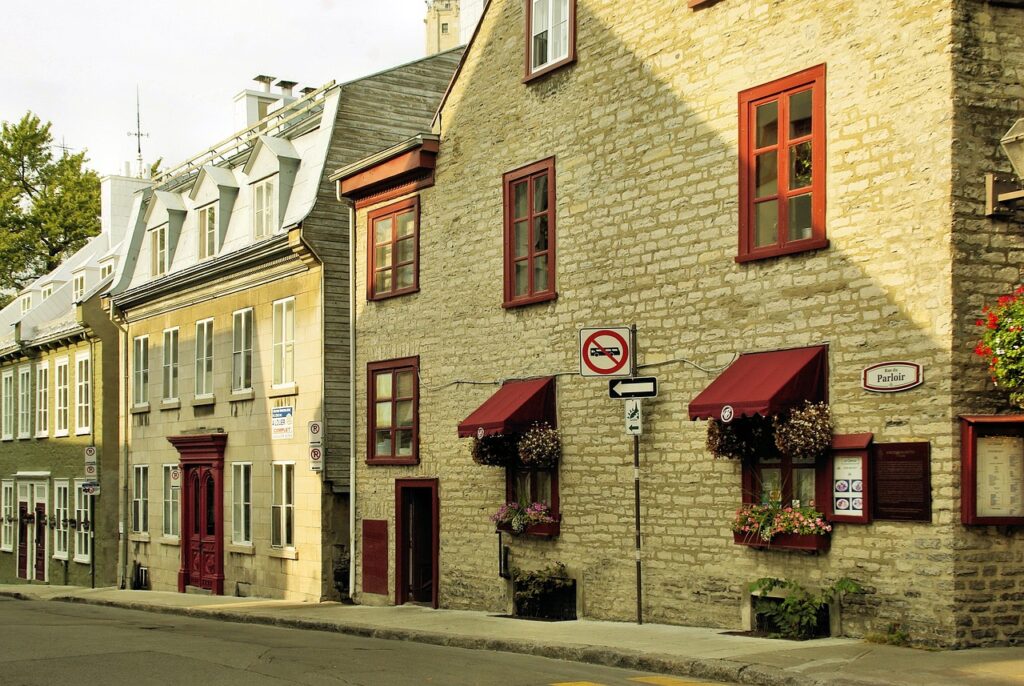
Most of the buildings are built of gray limestone, which gives the city a special flavor and recognizability. Characteristic narrow houses with high roofs and brightly colored facades create a unique atmosphere of a European medieval city.
Among the architectural masterpieces of Old Quebec, the Chateau Frontenac, a grand hotel built in the late 19th century in the style of French Renaissance castles, stands out. It is one of the most photographed structures in the world and a symbol of Quebec City.
Cultural heritage and tourist attractions
Key attractions
Old Quebec is a real treasure trove of historical and cultural monuments. Here are the main attractions worth visiting:
- Chateau-Frontenac is a luxurious chateau hotel built in 1893 by architect Bruce Price. Today, it is one of the symbols of Quebec and a National Historic Site of Canada.
- The Quebec Fortress (La Citadelle) is an actively used star-shaped military fortress built in the 19th century. It is still home to the Royal 22nd Regiment of the Canadian Armed Forces and is also one of the residences of the Governor General of Canada.
- Place Royale is the “cradle” of French civilization in North America. It was here that Samuel de Champlain established the first permanent French settlement in the New World.
- Notre-Dame-des-Victoires Church is a stone church built in 1688 on Place Royale. It is one of the oldest stone buildings in North America.
- Rue du Petit-Champlain is one of the oldest commercial streets in North America, now filled with cozy boutiques, cafes and restaurants.
- Terrasse Dufferin – A wide promenade overlooking the St. Lawrence River, named after Governor Dufferin, who saved the city walls from demolition.
- Quebec Cable Car – has connected the Upper and Lower Town since 1879, offering spectacular views of Old Quebec and the river.
- Place d’Armes – a historic square in the center of the Upper Town, surrounded by important buildings including the Château-Frontenac.
- TheParliament of Quebec is a grand Second Empire style building where the Quebec National Assembly meets.
- Quebec Seminary and Université Laval are the oldest educational institutions in Canada, founded in the 17th and 18th centuries.
Cultural life and festivals
Old Quebec is not just an open-air museum, but also a center of active cultural life. Various festivals and events are regularly held here:
- TheCarnaval de Québec (Winter Carnival) is the largest winter festival in the world and has been held since 1955. It is a colorful event with ice sculptures, parades and traditional winter entertainment.
- Festival d’été de Québec (Festival d’été de Québec) is one of Canada’s largest music festivals, attracting international stars.
- Les Fêtes de la Nouvelle-France is a festival that recreates the atmosphere of the 17th and 18th centuries, when Quebec was part of the French colonial empire. Participants dress in historical costumes, theatrical performances and colonial food tastings.
- Festival Juste pour rire de Québec (Festival Juste pour rire de Québec) is an annual event celebrating circus arts and comedy.
- Christmas in Old Quebec is a magical time when the historic center is transformed into a fairy tale with festive illuminations, Christmas fairs and special events.
Quebec as a tourist center
Old Quebec tourist destinations
Old Quebec is compact and ideal for hiking. There are several popular hiking routes that allow you to cover the main attractions:
- Upper Town route (2-3 hours): start at the Quebec Fortress, then visit Place d’Armes, Chateau Frontenac, Terrace Dufresne, Quebec Parliament building, Quebec Seminary and Notre-Dame-de-Québec Cathedral.
- Lower Town itinerary (2 hours): start at the Quebec cable car, then walk along Petit Champlain, visit Place Royale, Notre-Dame-de-Victoire Church and the Old Port waterfront.
- Circular route along the ramparts (1.5-2 hours): a unique opportunity to walk along the preserved ramparts surrounding the Upper Town, with stops at historic gates and bastions.
- Thematic itinerary “In the footsteps of New France’s history”: a tour dedicated to the French colonial period with visits to places associated with the first settlers and founders of the city.
- Gastronomic tour of Old Quebec: an itinerary with stops at traditional Quebec restaurants and cafes where you can sample authentic Quebec cuisine.
For those who prefer organized tours, there are many companies offering walking, bus and even horseback tours of the historic center. Evening tours with guides dressed in historical costumes telling the legends and mystical stories of Old Quebec are especially popular.
Quebec cuisine: culinary traditions and famous dishes
Quebec’s culinary traditions have been shaped by French, Irish and Native North American cultures. Here are some famous dishes to try when visiting Old Quebec:
- Poutine – Perhaps the most famous Quebec dish,poutine is French fries covered in cheese and gravy. Although poutine is relatively young (it only appeared in the mid-20th century), it has become a symbol of Quebec cuisine.
- Tourtière is a traditional meat pie, especially popular during the Christmas season. It is made of pork, beef or game with the addition of spices.
- Maple syrup pie (Tarte au sirop d’érable) is a sweet dessert based on maple syrup, the production of which is an important part of Quebec’s economy and culture.
- Fèves au lard (Fèves au lard) – Baked beans withlard, a traditional Quebec lumberjack dish.
- Pea soup (Soupe aux pois) – a thick soup made from yellow peas with added meat, especially popular during the cold season.
- Pâté chinois (Chinese pâté) – despite the name, this is a typically Quebec dish, which is a layered casserole of mashed potatoes, corn and minced meat.
- New France Sauce – a legendary sauce whose recipe is said to have been created by Governor Frontenac himself. It is prepared from a mixture of meat and chicken broth, mushrooms and herbs.
- Peasant soup with turnips is a traditional dish from New France times, made by French settlers. The soup combines cabbage, turnips, potatoes and flavorful herbs.
Old Quebec has many restaurants, cafes and bistros where you can try these and other traditional dishes. Especially recommended are the restaurants on Rue Petit-Champlain and around Place Royale, which often offer dishes prepared according to old recipes.
Modern life in a historic setting
How history and modernity come together
Despite its historic status, Old Quebec is a vibrant, dynamic neighborhood where the past blends harmoniously with the present. Old buildings house modern stores, restaurants, galleries and offices. Quebecers cherish their historical heritage, but do not turn the city into a museum frozen in time.
Preserving the historic appearance of Old Quebec is a priority for city officials. Any reconstruction or new construction must comply with strict rules so as not to disturb the unique architectural ensemble. At the same time, the city is gradually modernizing: historical buildings are being restored, infrastructure is being improved, and modern technologies are being introduced for the comfort of residents and tourists.
Tourism and its impact on the life of Old Quebec City
Tourism plays a crucial role in the economy of Old Quebec. Millions of tourists from around the world visit the historic center every year. On the one hand, it creates jobs, stimulates the development of the restaurant and hotel business, and contributes to the preservation of cultural heritage. On the other hand, mass tourism generates certain problems: rising real estate prices, displacement of local residents, overloading of the city infrastructure in high season.
The city authorities are trying to find a balance between tourism development and preservation of the authenticity of Old Quebec. They develop programs to support local entrepreneurs, regulate the number of tourist groups in certain areas, hold events to attract tourists in low season.
Off-the-beaten-path tourist destinations around Quebec City
For those who have already explored Old Quebec and want to expand their knowledge of the region, there are many interesting places around the city:
- Île d’Orléans is a picturesque island 15 minutes from Old Quebec City. Here you can visit wineries, cheese factories, lavender fields, bike along scenic trails and sample local produce.
- Montmorency Falls is an impressive waterfall 83 meters high (30 meters higher than Niagara Falls). Located just 12 km from the city center.
- Chaudière Falls is a lesser known but no less beautiful waterfall located in the town of Levis, opposite Quebec City.
- Canyon Sainte-Anne is a spectacular natural canyon with trails, suspension bridges and waterfalls.
- Wendake Guron Tribe – a preserved reservation of the indigenous Guron people where you can learn about their culture, traditions and cuisine.
- Parc national de la Jacques-Cartier is a magnificent natural park with mountains, valleys, rivers and lakes, ideal for hiking, kayaking and wildlife watching.
Practical tips for travelers
Best time to visit
Quebec is beautiful at any time of year, but each season has its own characteristics:
- Summer (June-August) is the most popular tourist season with warm weather and many festivals. However, it is also the time of the greatest influx of tourists and high prices.
- Autumn (September-October) is a great time to visit as the leaves turn bright fall colors, tourists are fewer and temperatures remain comfortable.
- Winter (December-March) is a fabulous time, especially during the Christmas holidays and Winter Carnival. The city is transformed by the snow, but be prepared for low temperatures (sometimes as low as -30°C).
- Spring (April-May) – gradual awakening of nature, fewer tourists, but the weather can be unpredictable, with possible rain and even late snowfalls.
How to get there and where to stay
Quebec City can be reached by a variety of ways:
- By plane: Jean-Lesage International Airport (YQB) is about 16 km from the city center.
- Train: Via Rail Canada connects Quebec with other major Canadian cities.
- Bus: Intercity bus companies such as Orléans Express provide regular service between Quebec and other cities.
- By car: Quebec is well connected to other regions by a network of highways.
There are plenty of options for lodging in Old Quebec:
- Luxury hotels: Chateau-Frontenac, Auberge Saint-Antoine, Hôtel Le Germain Québec.
- Boutique and historic hotels: Hôtel Clarendon, Hôtel du Vieux-Québec, Auberge Saint-Pierre.
- Budget options: hostels, guesthouses and apartments near Old Quebec.
It is recommended to book accommodation in advance, especially during the high tourist season and major festivals.
Conclusion: the uniqueness of Old Quebec City
Old Quebec is not just a historical center of a Canadian city, it is a living testimony of the European presence in North America, a unique example of preserving cultural heritage and harmonious combination of history and modernity.
Walking along the cobbled streets of Old Quebec, watching the majestic St. Lawrence River from the Dufresne Terrace, exploring the fortress walls or enjoying traditional Quebec cuisine in a cozy restaurant, you are involuntarily transported to another era and another continent. It is this feeling that makes Old Quebec so special and attractive to travelers from all over the world.
As the only fortified city in North America and a UNESCO World Heritage Site, Old Quebec is an invaluable cultural treasure not only for Canada, but for all of humanity. And although it has been more than four centuries since its founding, the city continues to tell its stories and reveal its secrets to those willing to listen and learn.
Traveling to Old Quebec is not just a tourist trip, it is an immersion into another culture, another era and another world that exists parallel to our modern one. It is an opportunity to become part of this unique place where past and present intertwine in an extraordinary dance of time.
Old Quebec represents a unique concept of historic preservation, where life continues to flow surrounded by centuries-old walls. Unlike many of the world’s historic centers that have become tourist attractions, Quebec remains a vibrant and dynamic city where history is not a museum piece, but part of everyday life.
The French heritage preserved in architecture, language and culture makes Quebec a true “slice of Europe” on the North American continent. The feeling of being in a French provincial town is enhanced by the linguistic environment – about 95% of the city’s population speaks French as a first language.
It is this authenticity and loyalty to its roots that makes Old Quebec so appealing to millions of tourists and so important to preserving the cultural diversity of North America. More than just a historical monument, Old Quebec is a living testament to the continent’s multifaceted cultural heritage.
Cultural aspects of modern Quebec
The French language and French-Canadian identity
Language is one of the most important components of Quebecers’ identity. Unlike most regions of Canada where English is the dominant language, Quebec remains a predominantly French-speaking province. This fact has deep historical roots and is linked to the determination of the descendants of French colonists to preserve their cultural identity after coming under British rule.
Quebec has strict language laws that protect the status of the French language. All signs, menus, and information boards must be primarily in French, although tourist sites often offer information in other languages as well.
Quebec French has its own peculiarities that distinguish it from French in France – a special accent, specific vocabulary, old French expressions that have survived here but have fallen out of use in France. For a tourist speaking standard French, some local expressions may seem unusual, but they form an important part of the cultural heritage of the region.
Literature, art and music
Quebec is the center of French-speaking culture in North America. It has developed its own literary traditions, theater, music and film. Famous Quebec writers such as Michel Tremblay, Anne Hébert, and Denis Temblé have created works that reflect the unique experience of French Canadians and their struggle to preserve their cultural identity.
Old Quebec is home to many art galleries featuring works by both historic Quebec artists and contemporary creators. Street artists and musicians, especially during the warmer months, enliven the squares and streets of the historic center, creating a unique atmosphere of creativity.
Quebec’s music scene is also very diverse, ranging from folk traditions to contemporary French-language pop. Internationally renowned artists such as Celine Dion began their careers in the Quebec music scene.
Social life and local traditions
Seasonal festivals and customs
Life in Old Quebec is not only subject to the tourist calendar, but also to traditional seasonal celebrations and customs, many of which date back to the colonial past.
In winter, especially in late December and early January, Old Quebec turns into a true Christmas fairy tale. Festive lights, Christmas markets and traditional entertainment create an unforgettable atmosphere. Catholic Christmas is celebrated with a special celebration, including a midnight mass at Notre-Dame-de-Québec Cathedral.
Winter Carnival, held in late January and early February, is the largest winter festival in the world. Its symbol is the smiling snowman Bonhomme. During the carnival, there are ice sculpting competitions, dog sled races, parades and various winter activities.
Summer festivals include St. Jean-Baptiste Day (June 24), Quebec’s national holiday, and Canada Day (July 1), which is celebrated with less enthusiasm than in the English-speaking provinces. There is also the Festival of New France in the summer, which recreates the atmosphere of the colonial era.
Quebecers’ way of life
Despite its tourist popularity, Old Quebec retains an authentic way of life for locals. This is evident in everyday rituals – morning coffee at a small café, shopping at farmers’ markets, and evening strolls along the fortress walls.
Quebecers are known for their friendliness and openness. They are proud of their culture and gladly share it with visitors. They appreciate when tourists show interest in their language and traditions, even if it’s just a few polite phrases in French.
Residents of Old Quebec, despite the area’s tourist popularity, maintain a measured pace of life. There is no rush here, and the culture of cafes and restaurants suggests leisurely enjoyment of food and socializing rather than a quick bite.
Natural attractions around Quebec City
The St. Lawrence River and its role in the city’s history
The St. Lawrence River is not just a waterway, it is the life nerve of Quebec City. Since the city’s founding, the river has shaped its destiny as a commercial and military center. Today, it continues to play an important role in the life of the city as a transportation route and a center of recreational activity.
From the Dufresne Terrace or from the height of the fortress walls, you can enjoy breathtaking views of the river, which changes its appearance depending on the season and the weather. In summer, cruise ships and ferries run along the river, connecting Quebec City with Levis on the opposite bank. In winter, parts of the river are covered in ice, creating fantastic winter scenery.
At the mouth of the St. Lawrence River, fresh river water and salty sea water mix, creating a unique ecosystem rich in various species of marine mammals, including beluga whales and seals. Whale watching cruises are a popular tourist attraction available from Quebec City.
Natural parks and reserves in the region
There are several impressive natural parks and reserves around Quebec City:
- Parc national de la Jacques-Cartier – Located just 30 minutes from the city,Parc national de la Jacques-Cartier offers numerous opportunities for hiking, kayaking, fishing and wildlife watching.
- Cap-Tourmente Nature Reserve (Réserve nationale de faune du Cap-Tourmente) – a crucial stopover for migratory birds, especially snow geese, which gather here by the tens of thousands during spring and fall migrations.
- TheRéserve mondiale de la biosphère du Lac-Saint-Pierre (Biosphere Reserve on Lake Saint-Pierre) – protected by UNESCO and home to many species of birds and other animals.
- Fjord du Saguenay – a unique geological formation where you can see real fjords without leaving North America.
These natural attractions are the perfect complement to the historical and cultural riches of Old Quebec, allowing tourists to enjoy not only the city’s architecture but also Quebec’s spectacular landscapes.
A fortified city in the context of world history
Comparison with other fortified cities of the world
Quebec is often compared to other historic fortified cities in Europe, such as Dubrovnik in Croatia, Carcassonne in France or Tallinn in Estonia. However, Quebec is unique in that it is the only surviving fortified city north of Mexico.
Unlike many European fortress cities that were founded in the Middle Ages, Quebec is a relatively young city, having emerged in the early 17th century. However, it has remarkably well preserved its original layout and architectural appearance.
What makes Quebec’s fortifications special is their evolution from French military architecture to British architecture. After the city came under British control in 1759, the new authorities significantly modernized the defenses, creating a unique hybrid of the two military engineering traditions.
The importance of Quebec in shaping Canada’s national identity
Old Quebec plays a special role in shaping Canadian identity as a symbol of the country’s French heritage. The dualism of French and English cultures is the foundation of modern Canada, and Quebec is a living embodiment of this dualism.
The history of confrontation and cooperation between French and English colonists, reflected in the architecture and culture of Old Quebec, shapes the perception of Canada as a country where different cultures can coexist while maintaining their uniqueness.
In today’s globalized world, Quebec’s experience in preserving its cultural identity in the face of the pressures of the dominant culture (Anglo-Saxon) is of particular interest to many regions with rich histories and unique traditions.
Environmental initiatives and sustainable tourism
Preservation of historical heritage and environmental challenges
Preserving the historic image of Old Quebec in the face of today’s environmental challenges requires a special approach. City authorities and heritage organizations are working to adapt historic buildings to climate change, introduce energy-saving technologies in renovations, and protect ancient structures from the effects of pollution.
Of particular concern is the impact of climate change on the condition of historic buildings. Increased precipitation levels, temperature fluctuations, increased freeze-thaw cycles – all this can have a negative impact on ancient masonry and wooden structures.
Approaches to sustainable tourism in Old Quebec
In recent years, Quebec has increasingly focused on the concept of sustainable tourism, which involves minimizing negative impacts on the environment and the local community while maximizing economic benefits.
Among the specific measures taken to promote sustainable tourism in Old Quebec are:
- Regulation of tourist flows: introduction of quotas on the number of tourist groups visiting certain sites, distribution of tourist routes to reduce pressure on the most popular attractions.
- Energy efficiency: introduction of energy-saving technologies in hotels and restaurants in the historic center, provided that the historic appearance of the buildings is preserved.
- “Green transportation”: development of pedestrian and bicycle routes, limiting automobile traffic in the historic part of the city, encouraging the use of public transportation.
- Educational tourism: developing programs that not only introduce tourists to historic sites, but also raise their awareness of the importance of preserving cultural heritage and the environment.
- Supporting local producers: encouraging restaurants and hotels to use local products and materials, which reduces carbon footprints and supports local economies.
Looking to the future: challenges and prospects for development
Challenges facing the historic city
Old Quebec, like many historic centers around the world, faces a number of challenges:
- Balance between tourism and everyday life: the need to find a balance between developing tourism infrastructure and preserving the city as a place for local people to live.
- Gentrification: rising real estate and rental values in the historic center, which may lead to the displacement of indigenous people and traditional businesses.
- Preserving authenticity: risk of turning the historic district into a tourist attraction devoid of real life and cultural content.
- Climate change: potential threats to historic buildings and infrastructure due to changing climatic conditions.
- Digitalization and modernization: the need to introduce modern technologies while preserving the historic appearance of the city.
Prospects for development and preservation of cultural heritage
Despite the existing challenges, Old Quebec has good prospects for sustainable development:
- Diversification of tourism: development of new forms of tourism such as gastronomic, educational, ecological, which can attract more conscious and interested visitors.
- Adaptive reuse: transforming historic buildings for new functions while preserving their architectural integrity.
- Technology integration: using digital technologies to improve the tourist experience and manage visitor flows without disrupting the historic character of the city.
- International cooperation: sharing experiences with other historic cities around the world on cultural heritage preservation and sustainable development.
- Community involvement: active participation of Quebecers in decisions about the future of their city, helping to preserve authenticity and cultural identity.
A final look at Old Quebec
Old Quebec is much more than a tourist attraction or historical monument. It is a living city with a rich past and a vibrant present, a place where every stone tells a story and every street holds the memory of events that have shaped not only Quebec but all of Canada.
What makes Old Quebec unique is its ability to preserve its cultural identity and historic character while remaining a modern, vibrant and evolving city. It is a rare example of how historical heritage can not only coexist with modern life, but also enrich it, creating a unique space where history is not something frozen in museum windows, but as a living fabric of everyday life.
A visit to Old Quebec is an opportunity not only to see impressive architectural monuments and enjoy beautiful views, but also to immerse yourself in the special atmosphere of a place where European history and culture took deep roots on North American soil. This is a chance to experience a unique cultural experiment that has resulted in modern Quebec – French in spirit, Canadian in citizenship and unique in essence.
Old Quebec proves that caring for the past does not mean stagnation and refusal to develop. On the contrary, respect for history and tradition can be the basis for creating a viable, sustainable and attractive urban space that looks to the future. This may be the main lesson that this amazing fortress city on the banks of the St. Lawrence River can teach us.
Author Information

I’m a journalist specializing in urban issues and city politics in the Vancouver region, which I’ve covered since 1994, and I also have a strong focus on the iGaming industry. In this endlessly changing city, I cover a broad range of issues: from drug policy, bike lanes, billion-dollar development projects, homelessness, and garbage debates, to the rapidly evolving world of online gaming, including regulatory landscapes, technological advancements, and market trends. I write frequently for the Globe and Mail’s B.C. section and Report on Business. From 2008 to 2015, I had a regular column in Vancouver magazine, “Urban Fix,” which apparently resonated with readers so much that it earned me a few regional and national awards.