

Introduction: A symbol of Canadian power
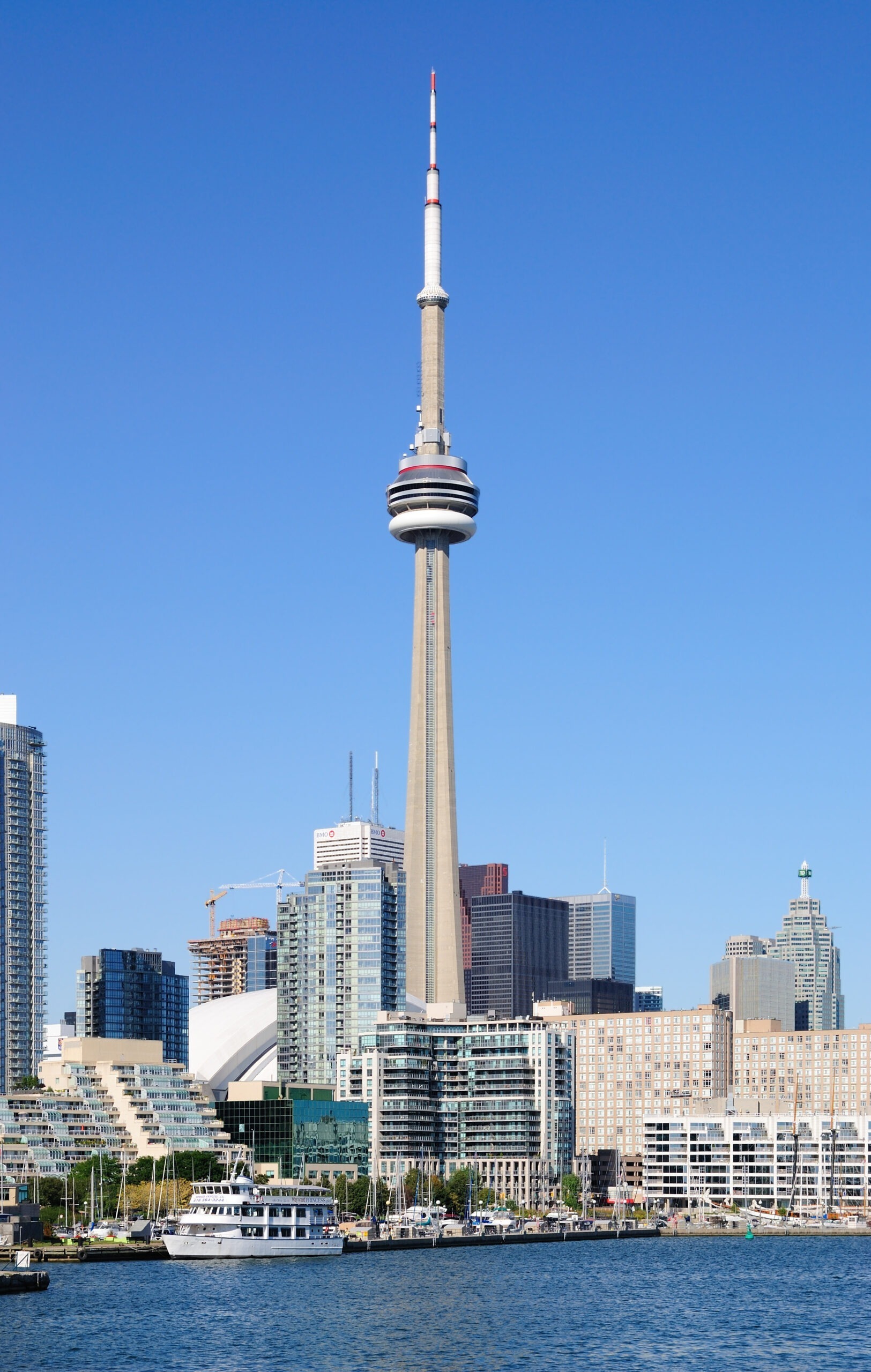
CN Tower is more than just a television tower in downtown Toronto. It is Canada’s national pride, an architectural marvel and a tourist magnet attracting millions of visitors from around the world each year. Rising majestically above the cityscape at a height of 553.3 meters, the tower has become an integral part of Toronto’s skyline and a symbol of Canadian engineering excellence.
In the 1970s, when Toronto’s construction industry was booming, high-rise buildings began to pose problems for television and radio broadcasting. Signals could no longer spread unimpeded throughout the city, reflecting off the many high-rise buildings. The Canadian National Railway solved this problem by building the tallest structure in the world, which not only solved the technical issues, but also became a symbol of Canada’s prosperity and innovative spirit.
Today, CN Tower offers visitors an unforgettable experience, from breathtaking observation decks with panoramic views and a glass floor to a gourmet revolving restaurant and an extreme EdgeWalk attraction. In this article, we take a virtual journey to the top of this impressive structure, revealing its history, design features and the attractions on offer.
History of creation: Birth of a giant
Prerequisites of construction
In the 1960s, Toronto was experiencing an unprecedented construction boom. The city was rapidly transforming from a regional center to a cosmopolitan metropolis. However, this rapid vertical expansion created an unexpected problem – the existing transmission towers were not tall enough to broadcast radio and television signals over the new high-rise buildings. The signals were reflected off the skyscrapers without reaching the target audience.
To solve this problem and demonstrate the ambition of Canadian industry, Canadian National, the public corporation that operated the country’s largest railroad network, made the bold decision to build the tallest tower in the world, capable of transmitting signals long distances across the region.
Beginning of construction
The site for the future tower was chosen between Front Street and Lake Ontario, on what is known as Railway Lands. This land, owned by CN Railway, was reclaimed from Lake Ontario during the previous century and was used for decades as the main rail yard in downtown Toronto.

Work on the CN Tower began on February 6, 1973. Construction crews began removing over 56 metric tons of earth and shale for the foundation. Once the foundation was prepared, work began on the tower’s 335-meter concrete shaft, a hexagonal core with three curved support arms.
To create the cone-shaped outline of the tower, construction crews poured concrete into a massive mold known as a slip formwork. As the concrete cured, the formwork, supported by a ring of lifting jacks powered by hydraulic pressure, was moved upward, gradually shrinking in size to give the tower its characteristic curved shape.
Completion of construction
By February 1974, the tower had already become the tallest structure in Canada. In August 1974, work began on the seven-story sphere that would later house the observation decks and the 360 revolving restaurant.
CN Tower was nearing completion in March 1975 when a giant Sikorsky helicopter, nicknamed “Olga,” flew into town to lift 39 pieces of the antenna. Despite high winds and low temperatures, the pilot managed to guide the parts into position before workers secured them in place. The entire mast was then covered with fiberglass reinforced sheathing to prevent icing.
CN Tower was completed on April 2, 1975 and opened to the public on June 26, 1976. At 553.3 meters (1,815 feet), it remained the tallest free-standing structure in the world until it was surpassed by the Burj Khalifa in Dubai in 2009. Nevertheless, CN Tower remains the tallest free-standing structure in the Western Hemisphere and one of the tallest television towers in the world.
In 1995, Canadian National sold CN Tower to Canada Lands Company, a federal crown corporation specializing in landmarks of national significance. It was then that the tower truly became the National Tower of Canada – both in name and in fact.
Architectural features: An engineering marvel
Engineering Features
CN Tower is an outstanding example of engineering and thoughtful architectural design. The tower stands 553.33 meters (1,815 feet) tall, making it the third tallest television tower in the world and the tallest free-standing structure in the Western Hemisphere.
The tower is based on a concrete base with three supporting “legs” that rise up and join at the tower trunk. At a height of about 450 meters is the main seven-story capsule, which houses observation decks and a restaurant. Above it rises an additional SkyPod platform and then a metal spire with antennas.
The construction of the tower required:
- 40,522 cubic meters of concrete
- 129 cubic meters of wood
- More than 5,300 tons of reinforced steel
- 530 tons of structural steel
The structure of the tower is designed to withstand earthquakes and can withstand wind loads of up to 418 kilometers per hour. In high winds, the top of the tower can swing up to 1.07 meters.
Unique design solutions
One of the most innovative features of CN Tower is its construction method. A self-climbing sliding formwork was used to form the tapered contour of the tower. Concrete was continuously poured into the formwork, and after curing, the formwork was lifted higher using hydraulic jacks. This process continued continuously, 24 hours a day, until the desired height was reached.
Another unique solution is the lightning protection system. About 75-78 lightning strikes the tower every year, but a special system of lightning rods makes it possible to divert electric discharges without causing damage to the structure and electronic equipment.
The tower also has special illumination. In 2007, CN Tower was equipped with a modern lighting system using 1330 energy-saving LEDs. Usually the tower is illuminated in the colors of the Canadian flag – a combination of red and white colors, but on holidays or special dates the palette can be changed, creating unique lighting compositions.
Observation levels and design features
CN Tower has several levels for visitors, each with its own features:
- Main Observation Level – Located at 346 meters (114 floors). The main observation decks are located here, with 360-degree views of Toronto and Lake Ontario.
- Lower Observation Level – at a height of 342 meters (113 floors). It features the famous glass floor, an outdoor terrace and the new interactive art installation, Artmosphere.
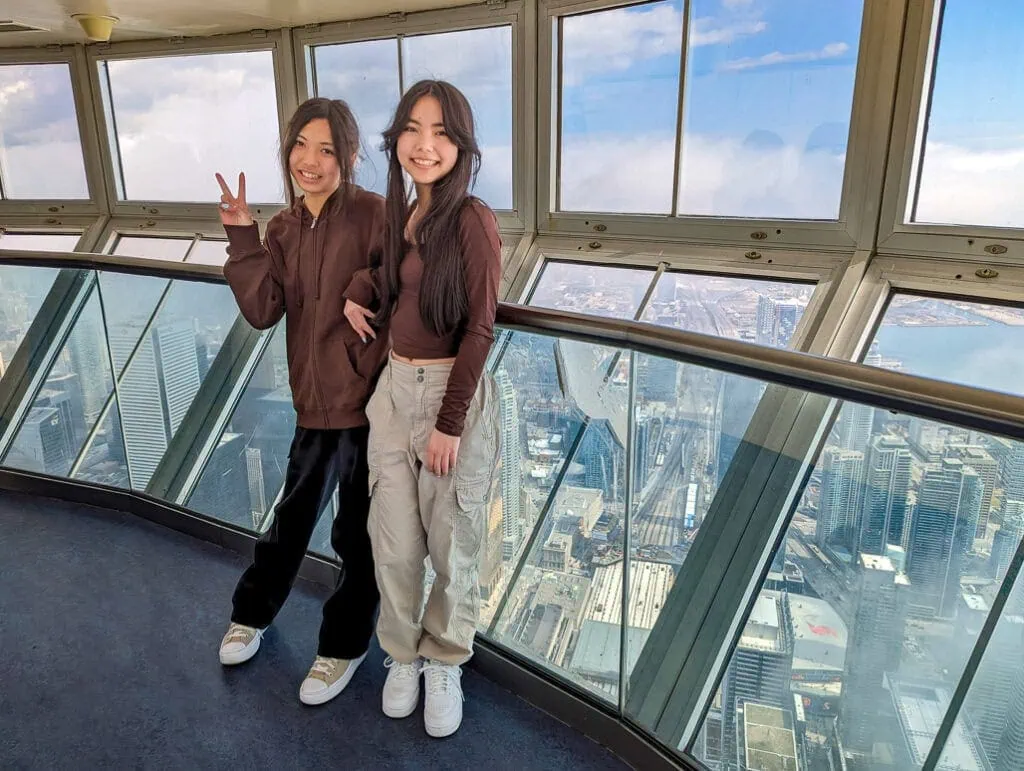
- SkyPod – an additional observation deck at 447 meters (1,465 feet), 33 floors above the main observation levels. It is the highest observation deck on the continent, from which, in clear weather, you can see up to 160 kilometers into the distance – to the US border and even to Niagara Falls.
- Restaurant 360 – a rotating restaurant at 351 meters high, making a full revolution every 72 minutes and offering diners panoramic views of Toronto during lunch or dinner.
- EdgeWalk – an exterior circularwalkway on the roof of the main dome at 356 meters (116 stories). It is the world’s tallest hands-free full-circle ride and the first of its kind.
Visit CN Tower: Climbing to the Clouds
Tickets and opening hours
CN Tower is one of Toronto’s top tourist attractions, and it is recommended that you plan your visit in advance to maximize your experience. The tower offers several ticket options:
- Timed General Admission – A basic option that includes access to the Main and Lower Observation Levels. An adult ticket (ages 14-64) costs $45 CAD if purchased in advance online and $47 CAD if purchased on the day of the visit. There is a discounted price of $32/$34 CAD for seniors (65 ) and youth (6-13 years old) respectively, and $16/$18 CAD for children (3-5 years old). Children under 2 years old visit the tower for free.
- The Top Timed General Admission is an advanced option that includes access to the Main and Lower observation levels, as well as the SkyPod platform. The cost is $56 CAD for adults, $43 CAD for seniors and youth, and $27 CAD for children.
- Premier – VIP package is $95 CAD and includes priority access to elevators and observation platforms including SkyPod, exclusive (private) elevator, 15% discount in the gift store and other privileges.
- EdgeWalk – An extreme attraction starting at $199 CAD that includes a 30-minute walk along the outer edge of the tower at 356 meters with an instructor, a certificate of achievement, a video, two printed photos and a ticket to visit the rest of the tower, including the SkyPod.
Combination tickets with other Toronto attractions are also available:
- Sea the Sky – CN Tower and Ripley’s Aquarium combination ticket
- Toronto CityPASS – a package that includes a visit to 5 of Toronto’s top attractions, including CN Tower
The operating hours of CN Tower may vary depending on the season, but usually the tower is open for visitors from 10:00 to 21:00. For up-to-date information, it is recommended to check the official website before visiting.
Visiting the main observation decks
A visit to CN Tower begins with going through security check and purchasing tickets (if not purchased in advance). Visitors then take high-speed elevators to the Main Observation Level (346 meters). The ride takes only 58 seconds! The elevators have a glass floor and a glass back wall, allowing you to watch the ascent process.
The Main Observation Level offers stunning 360-degree views of Toronto, Lake Ontario and the surrounding area. In good weather, visibility can reach 160 kilometers, allowing you to see the border with the United States and even the haze of Niagara Falls. There are also information boards about the tower and the city, as well as cafes and souvenir stores.
Descending one level lower, visitors reach the Lower Observation Level (342 meters), where the famous glass floor is located. This transparent section of the floor is 23.8 square meters in area and 6.35 centimeters thick and can support the weight of 14 hippos! Standing on this floor, visitors can literally float above Toronto, observing the city 342 meters beneath their feet.
On the same level is the Outdoor Terrace, an open platform that allows you to feel the breeze and hear the sounds of the city from above. It is also home to the OverView attraction, tilted glass panels that allow visitors to “lean” over the city.
SkyPod: Above the Clouds
For those who want to go even higher, an additional observation deck, SkyPod, is available at a height of 447 meters. This is 33 floors above the main observation levels and offers the most impressive views. On clear days, you can see the American state of New York and even Niagara Falls from here.
At this height, visitors can already feel the tower swaying slightly in strong winds. The SkyPod also houses a permanent photo exhibit on the history of CN Tower’s construction, making a visit to this level not only visually impressive but also an educational experience.
EdgeWalk: a walk on the edge
EdgeWalk is an extreme attraction for those for whom ordinary observation decks are not enough. It is the world’s first full-circle hands-free ride at a height of 356 meters (116 floors). EdgeWalk participants, dressed in special suits and securely fastened with safety ropes, take a 30-minute walk along the outer edge of the roof of the main dome of the CN Tower.
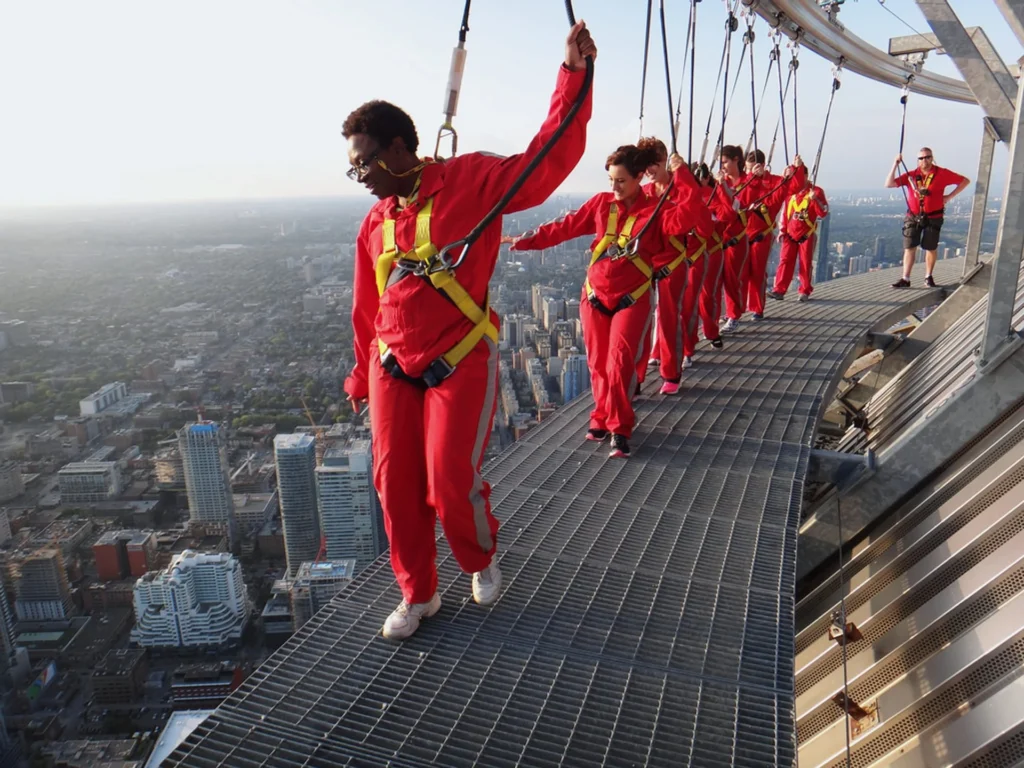
The experience begins with a meeting at EdgeWalk Base Camp on the first floor, where a full briefing is conducted before ascending to the Summit Room, located two floors above the Main Observation Level. There, participants are strapped to the rails and the walk begins. Starting on the south side of the tower above the 360 Restaurant, attendees follow the instructor around the circumference of the building before returning. The entire experience takes about 90 minutes from start to finish, of which 30 minutes are spent directly on the EdgeWalk.
During the walk, instructors offer participants different poses, such as leaning back over the edge or hanging with only a safety rope to hold on to – all under the reliable supervision of professionals and with the strictest safety precautions. Instructors are equipped with cameras, and all participants receive a video and two printed photos of their extreme experience, as well as a certificate of achievement.
EdgeWalk is only held under favorable weather conditions – it is canceled during electrical storms, dangerously high winds or other extreme weather conditions.
Restaurant 360: Dining with a City View
A unique rotating restaurant
One of CN Tower’s most impressive features is Restaurant 360, located 351 meters (1,151 feet) above the ground. This elegant establishment is not just a restaurant, but a true gastronomic attraction offering a unique dining experience with an ever-changing view.
The main feature of the restaurant is its rotating platform, which makes a complete revolution every 72 minutes. This gives diners the opportunity to enjoy panoramic views of Toronto and Lake Ontario during lunch or dinner without having to get up from their seat. The gentle, almost imperceptible rotation makes it feel like the city itself is slowly floating by outside the windows while you enjoy the exquisite cuisine.
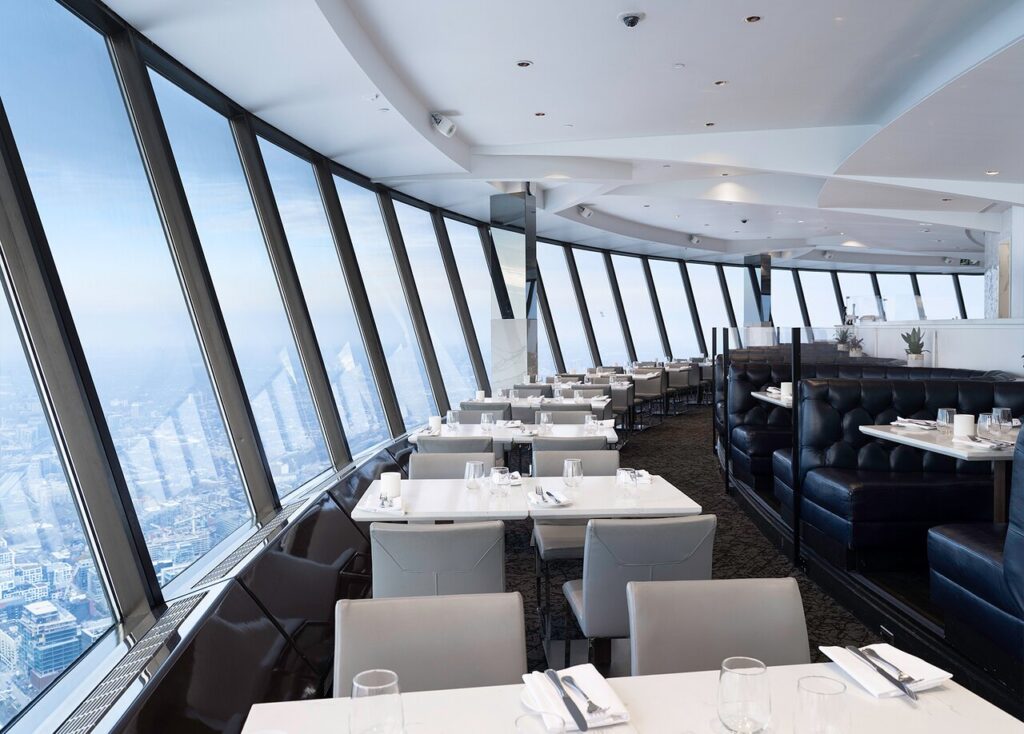
The restaurant is decorated in a modern style with elegant furniture and minimalist design so as not to distract from the main advantage – the stunning view. The tables are located by the windows, giving all guests an unobstructed view. The restaurant’s capacity is up to 400 guests, but the thoughtful layout of the space creates an atmosphere of privacy and comfort.
A culinary journey across Canada
Restaurant 360 offers not only unique views, but also a gastronomic journey across Canada. The restaurant’s menu is a sophisticated combination of steakhouse, seafood restaurant and wine bar, with an emphasis on regional Canadian specialties and Ocean Wise certified sustainably harvested fish and shellfish.
The restaurant’s talented culinary team carefully selects the freshest and most sustainable ingredients to introduce guests to the flavors and textures of Canada’s diverse regions, from coast to coast. The menu includes both fixed sets (prix fixe) and à la carte options.
The restaurant is especially proud of its impressive wine collection, which showcases the best local flavors from Ontario-grown grapes crafted by the province’s most talented winemakers. restaurant 360’s “Wine Cellar in the Sky” offers the perfect pairings to any meal.
Dining Experience and Value
A visit to Restaurant 360 is not just a lunch or dinner, but a complete experience that combines gastronomy and tourism. Guests of Restaurant 360 are required to spend a minimum of CAD$75 on a meal per person (minimum is CAD$40 for children ages 4 to 12), which includes a lift to the restaurant and access to the CN Tower Main Observation Level after the meal.
Keep in mind that 360 Restaurant guests do not need to purchase a separate CN Tower admission ticket. They are free to visit the Main Observation Deck after lunch or dinner to enjoy the view separately from their meal.
The restaurant is open for lunch and dinner and it is recommended to make reservations in advance, especially for sunset hours and weekends when the restaurant can be particularly popular. The dress code at the restaurant is considered “smart casual” – it is recommended to dress elegantly but comfortably.
For special occasions such as anniversaries, birthdays or romantic proposals, the restaurant also offers special packages and the possibility of organizing unique events.
Interesting facts about CN Tower
Records and achievements
- CN Tower held the title of thetallest free-standing structure in the world for a long time, from its completion in 1976 until 2007, when the record passed to the Burj Khalifa skyscraper under construction in Dubai. Despite the loss of the world championship, CN Tower remains the tallest free-standing structure in the Western Hemisphere.
- CN Tower is listed in theGuinness Book of World Records in several categories, including “World’s Tallest Wine Cellar” – Restaurant 360’s wine collection has over 500 varieties and sits at 351 meters.
- Apinnacle of engineering In 1995, the American Society of Civil Engineers listed CN Tower as one of the “Seven Wonders of the Modern World” along with structures such as the Channel Tunnel and the Panama Canal.
- The EdgeWalkextreme ride at CN Tower is the world’s tallest full-circle “hands-free” ride and the first of its kind. The ride opened on August 1, 2011 and has since become a popular experience for adrenaline seekers.
Technical and architectural features
- Weather Resistant The CN Tower is designed to withstand winds of up to 418 km/h and earthquakes. In high winds, the top of the tower can deflect up to 1.07 meters, but the structure remains completely safe.
- Lightning and protection Every year CN Tower is exposed to approximately 75-78 lightning strikes. The tower is equipped with a special lightning rod system that effectively diverts electrical discharges, protecting the structure and electronic equipment.
- Illumination In 2007, CN Tower was equipped with a state-of-the-art lighting system utilizing 1,330 energy-saving LEDs. This system is not only spectacular but also environmentally friendly, requiring minimal maintenance. Normally, the tower is lit in the colors of the Canadian flag – red and white, but on special days the palette may change.
- High-Speed E levators The elevators in CN Tower travel at 22 km/h (6 m/s), taking visitors from the lower level to the Main Observation Level in just 58 seconds. These are some of the fastest elevators in the world.
Cultural significance
- A symbol of Toronto and Canada, CN Tower has become an integral part of Toronto’s skyline and a recognizable symbol of all of Canada. The tower frequently appears in films, television programs and photographs representing Toronto or Canada as a whole.
- Popular culture and cinema CN Tower has “starred” in many movies and television series. Especially notable is the 1979 movie Highpoint, where stuntman Dar Robinson performed a unique jump from the tower, becoming the first person to perform such a stunt.
- Tourist Magnet More than 2 million tourists visit the CN Tower each year, making it one of Canada’s most visited attractions and an important element of Toronto’s tourism infrastructure.
- Watching baseball The CN Tower offers a great view of Rogers Centre (formerly known as the SkyDome), the home stadium of the Toronto Blue Jays. On sunny days during baseball season, Rogers Centre opens the roof of the stadium and people on the CN Tower observation decks or participating in EdgeWalk can get a bird’s eye view of baseball games.
Practical information for visitors
How to get there
CN Tower is located in the heart of Toronto at 290 Bremner Boulevard, Toronto, Ontario M5V 3L9. Getting to the tower is easy, as it is located in the central part of the city near other popular attractions.
By public transportation:
- Subway: the nearest station is Union Station. From there, CN Tower can be reached on foot in 5-10 minutes by following the signs or heading west on Front Street, then south on John Street or Blue Jays Way.
- Streetcar: Routes 509 and 510 stop at Harbourfront, which is an easy walk to the tower.
- Train: If you are arriving in Toronto by train, the final station is Union Station, from which you can walk to CN Tower.
By car: CN Tower is close to several paid parking lots. However, it can be difficult to find a spot in the city center, especially on weekends or during major events. Public transportation or cabs are recommended.
Walking: If you are already in downtown Toronto, the CN Tower is easily walkable from many hotels and attractions. The tower is highly visible from many points downtown and serves as a great landmark.
When is the best time to visit
CN Tower is open to visitors all year round, and each season offers its own benefits:
Time of year:
- Summer (June-August) is the most popular tourist season with the highest number of visitors. The weather is usually warm and clear, providing great views, but be prepared for lines.
- Fall (September-November) is a great time to visit as the crowds are smaller and the weather is often clear. The fall colors make the views especially picturesque.
- Winter (December through February) is the least crowded time. Visibility can be exceptional on clear winter days, but sometimes fog or snowfall can limit views. EdgeWalk does not operate during this time of year due to weather conditions.
- Spring (March-May) is a pleasant time to visit, when the city is starting to turn green and there are still not as many tourists as in the summer.
Time of day:
- Morning – usually fewer visitors, especially on weekdays
- Sunset – offers the most scenic views when the town and lake are illuminated in golden light, but it is also the most popular time
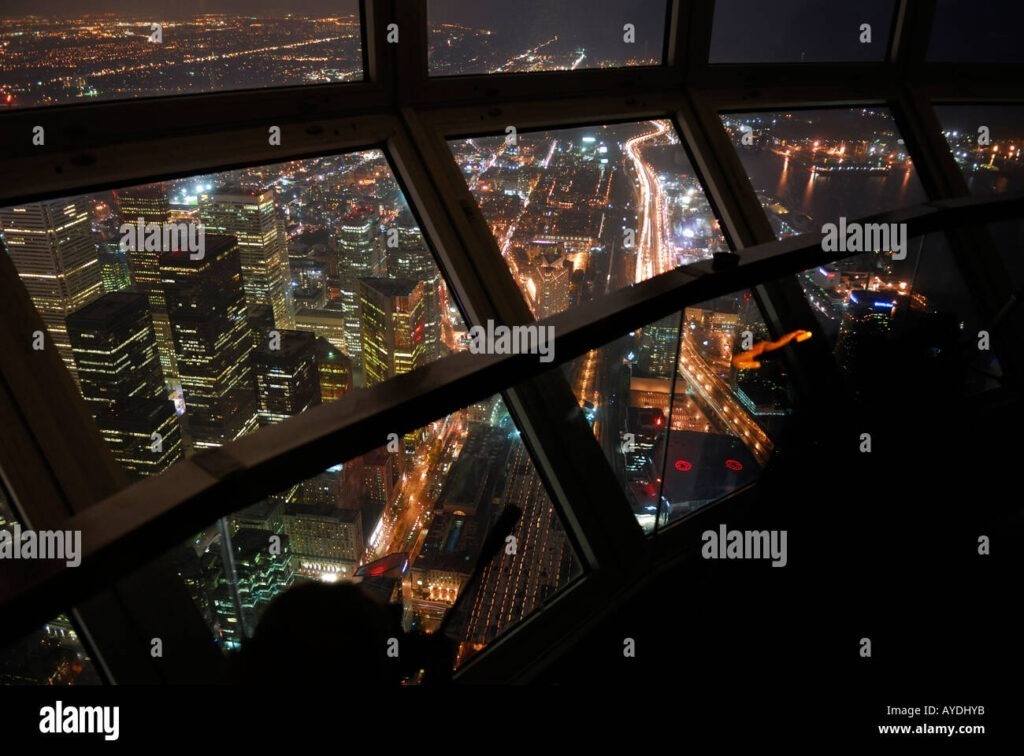
- Night – a special experience when you can see the city illuminated by millions of lights
Many tourists choose to visit CN Tower twice during the day – during the day to enjoy the daytime views and visit the EdgeWalk (if scheduled), and in the evening to see the sunset and the city at night.
Tips for a comfortable visit
- Buy tickets in advance Purchasing tickets online not only allows you to save money (tickets are slightly cheaper when purchased in advance), but also to avoid lines at the box office. Plus, popular attractions like EdgeWalk are often fully booked, especially during high season.
- Choose a weather-sensitive time Before visiting, check the weather forecast. Visibility can be severely limited on foggy or rainy days. The ideal time to visit is on a clear day with good visibility.
- Dress appropriately It can be cooler at altitude than at ground level, even on summer days. Also, if you plan to go out on the Outdoor Terrace or participate in the EdgeWalk, the wind at altitude can be quite strong. Clothing should be comfortable, especially shoes, as there will be a lot of walking and standing.
- Useful Accessories Bring binoculars if you want to view distant objects and a camera for photos. However, keep in mind that for EdgeWalk, all personal items, including cameras and phones, should be left in lockers.
- Plan enough time A minimum of 2-3 hours is required for a full visit to CN Tower with a tour of all levels and attractions. If you are planning a lunch or dinner at 360 Restaurant, add another 1.5-2 hours. For the EdgeWalk, you should plan on about 90 minutes.
- Consider Combination Tickets If you plan to visit multiple Toronto attractions, consider purchasing Toronto CityPASS or other combination tickets that can offer significant savings.
- Accessibility CN Tower strives to be accessible to all visitors. The tower has elevators, adapted restrooms, and other amenities for people with disabilities. Even the EdgeWalk is wheelchair accessible for some visitors using specially designed equipment (prior arrangement required).
CN Tower neighborhood: what else to see
Neighboring Attractions
CN Tower is located in the heart of Toronto, and there are many other interesting places to visit around it:
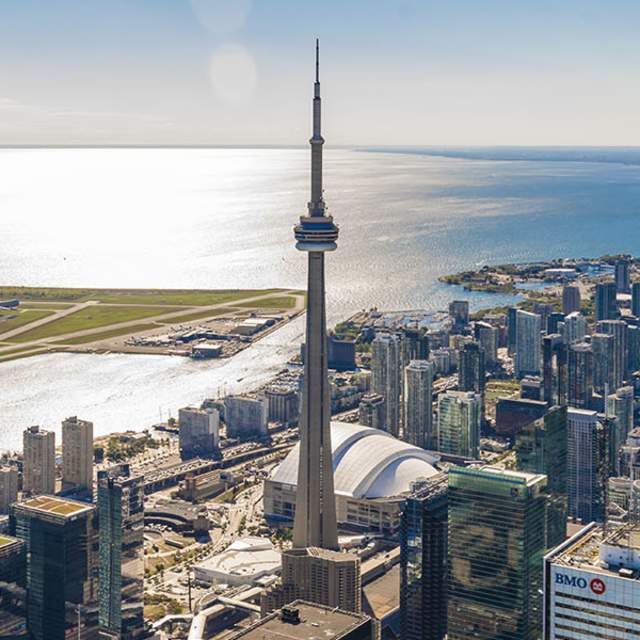
- Rogers Centre (formerly SkyDome) is a multi-purpose stadium, home of the Toronto Blue Jays team. It is literally just steps away from the CN Tower. If there is a game going on during your visit, you can combine a visit to the tower with watching a baseball game.
- Ripley’s Aquarium of Canada is a state-of-the-art aquarium located at the foot of CN Tower. It features more than 16,000 marine and freshwater creatures from around the world. Particularly impressive is the underwater tunnel where you can watch sharks and other large fish.
- Steam Whistle Brewing – A brewery located in the historic John Street Roundhouse railroad depot. Offers tasting tours and tells the history of brewing in Canada.
- Scotiabank Arena – A major sports and entertainment arena, home to the Toronto Maple Leafs hockey team and the Toronto Raptors basketball team. It also hosts major concerts and events.
- Harbourfront Centre – A cultural center on the shores of Lake Ontario with exhibition halls, theaters and restaurants. Festivals, concerts and other events are often held here.
Entertainment and restaurants near the tower
The area around CN Tower offers many options for entertainment and dining:
Entertainment:
- The Rec Room – a modern entertainment complex with arcade games, restaurants and bars.
- Toronto Railway Museum – A small but interesting museum of Canada’s railroad history.
- LEGOLAND Discovery Centre Toronto – a paradise for children and adult LEGO fans.
- Lake Walks – ferries to the Toronto Islands depart from the Ferry Docks terminal near the CN Tower and offer great views of the city skyline from the water.
Restaurants & Cafes:
- Real Sports Bar & Grill – A huge sports bar with multiple screens for watching the games.
- Amsterdam BrewHouse – Restaurant and brewery with a terrace overlooking the lake.
- Wayne Gretzky ‘s – a restaurant dedicated to the legendary hockey player with Canadian cuisine.
- St. Lawrence Market – A historic market (a little further from the tower) where you can find a variety of local delicacies and farm products.
Shopping:
- CF Toronto Eaton Centre – a huge shopping center with hundreds of stores located within a 10-15 minute walk from the CN Tower.
- Yorkville – an area of fashionable boutiques and designer stores (requires a transit ride).
- Queen Street West – a street known for its trendy stores, galleries and cafes.
CN Tower’s impact on Toronto’s development
Economic significance
CN Tower has played an important role in Toronto’s economic development, becoming one of the city’s major tourist magnets:
- Tourist Flow Every year, CN Tower attracts more than 2 million visitors, many of whom come to Toronto specifically to see the landmark. This directly contributes to the city’s tourism industry, from hotels and restaurants to transportation services and gift stores.
- CN Towerjobs support more than 500 people throughout the year, from maintenance staff to security specialists, administrators and EdgeWalk instructors. In addition, the tower indirectly creates many other jobs in related industries.
- Infrastructure Development The construction of CN Tower has been a catalyst for the development of the surrounding area. The former railroad land has been transformed into a vibrant neighborhood with entertainment venues, hotels, restaurants, and residential developments.
- International Marketing As a symbol of city and country, CN Tower is widely used in marketing materials promoting Toronto and Canada on the international stage, helping to attract not only tourists, but also business, investment and talent.
Cultural and architectural significance
CN Tower has become not just a technical structure, but a cultural phenomenon that has influenced the identity of Toronto and Canada as a whole:
- A symbol of progress and innovation At the time of its creation, CN Tower was an impressive demonstration of Canadian engineering capability and ambition. It has become a symbol of technological progress and national pride, showing that Canada is capable of world-class engineering excellence.
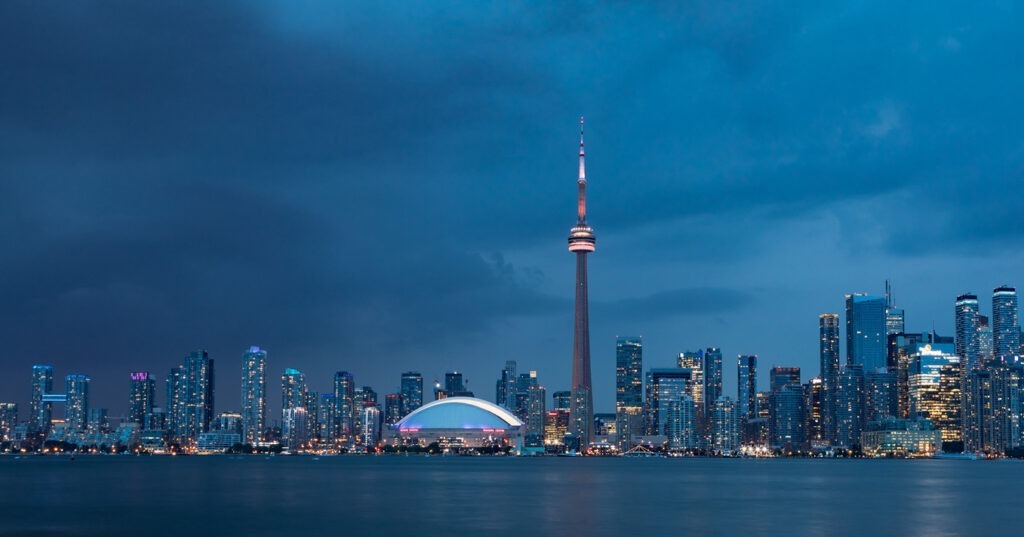
- Shaping the city’s silhouette, CN Tower forever changed the face of Toronto, becoming its most recognizable landmark. The silhouette of the tower is so closely associated with the city that it is often used as an abbreviated visual code to identify Toronto in movies, television shows and advertisements.
- Influence on Architecture The successful construction of the CN Tower demonstrated new possibilities in high-rise construction and inspired architects around the world to create other impressive tower structures. The construction methods used in the construction of CN Tower were subsequently applied to other projects.
- CN Tower’seducational value serves not only as an entertainment attraction, but also as an educational platform. Informative exhibitions inside the tower educate visitors about engineering, architecture, the city’s history and technological advancements, thus educating millions of people every year.
The future of CN Tower
Modernization and upgrades
CN Tower, although built almost 50 years ago, is constantly being updated to meet today’s safety, environmental and comfort standards:
- Observation Deck Updates Recently, CN Tower’s Lower Observation Level underwent a major renovation. A new interactive Artmosphere art installation was added, the glass floor was refreshed and the Outdoor Terrace was expanded. An “OverView” attraction with tilting glass panels was also added.
- Environmental Initiatives CN Tower is actively implementing green technologies. In 2007, an energy-efficient LED lighting system was installed, which not only creates spectacular light shows, but also uses 60% less energy than the previous system. Other green practices such as recycling programs and the use of sustainable materials in renovations are also being implemented.
- Technological Improvements CN Tower is continually updating its technology infrastructure to incorporate the latest advances in telecommunications. As an operating transmission tower, it continues to serve more than 17 Canadian television and FM radio stations, constantly upgrading its equipment.
Role in modern Toronto
CN Tower continues to play an important role in the life of modern Toronto:
- A center forcelebrations and events The Tower serves as the focal point for many of the city’s celebrations. CN Tower’s special lighting changes to reflect holidays, important dates and events – the tower may be painted in the colors of the national flag on Canada Day, a rainbow scheme during Pride Week, or other colors to support various charitable and social initiatives.
- The CN TowerTechnology Centre continues to serve as Toronto’s key telecommunications infrastructure, broadcasting signals across the region in an era where reliable connectivity is increasingly important.
- CN Tower’s education platform is increasingly being utilized as an educational platform where high school and college students can learn about physics, engineering, architecture and the city’s history. Educational programs are constantly expanding and adapting to modern teaching methods.
- CN Tower’s tourism innovation continues to develop new attractions and visitor experiences to remain competitive among the growing number of tourist attractions. The success of EdgeWalk has shown that even a mature attraction can offer innovative and exciting new experiences.
Conclusion
CN Tower is more than just an impressive engineering structure or a popular tourist attraction. It is a true symbol of Canada, an embodiment of its technological achievements, ambition and drive for innovation.
Built more than 45 years ago as a solution to a practical problem in television broadcasting, the tower has surpassed its original purpose, becoming an iconic architectural structure that shapes Toronto’s identity and is recognizable around the world.
For visitors to Toronto, CN Tower offers a unique experience – the chance to see one of North America’s most beautiful cities from a bird’s eye view, experience the thrill of walking on a glass floor 342 meters above the ground, enjoy fine dining in a smoothly rotating restaurant, or experience an adrenaline rush during an EdgeWalk.
But beyond the tourist experience, the tower continues to serve important functions for the city and its residents – from telecommunications infrastructure to a cultural and economic catalyst, spurring development in surrounding neighborhoods and bringing international attention to Toronto.
In a world where technology and architectural trends are constantly changing, CN Tower remains timeless, continuing to impress new generations of visitors with its scale, elegance and technical excellence. As the tower’s unofficial motto states, “Canada on High,” and CN Tower literally and symbolically brings these words to life.
Whether you venture on an extreme EdgeWalk, enjoy a leisurely dinner at 360 Restaurant, or simply take in the stunning views of the city from the main observation decks, a visit to CN Tower will be one of the most memorable experiences of your trip to Toronto and Canada as a whole.
As one visitor wrote, “To see Toronto from the CN Tower is to see Toronto for real. It’s not just a tower – it’s a whole world compressed into a vertical experience leading from earth to sky, from the historical past to the technological future. It’s a journey everyone should take.”
Author Information

I’m a journalist specializing in urban issues and city politics in the Vancouver region, which I’ve covered since 1994, and I also have a strong focus on the iGaming industry. In this endlessly changing city, I cover a broad range of issues: from drug policy, bike lanes, billion-dollar development projects, homelessness, and garbage debates, to the rapidly evolving world of online gaming, including regulatory landscapes, technological advancements, and market trends. I write frequently for the Globe and Mail’s B.C. section and Report on Business. From 2008 to 2015, I had a regular column in Vancouver magazine, “Urban Fix,” which apparently resonated with readers so much that it earned me a few regional and national awards.