

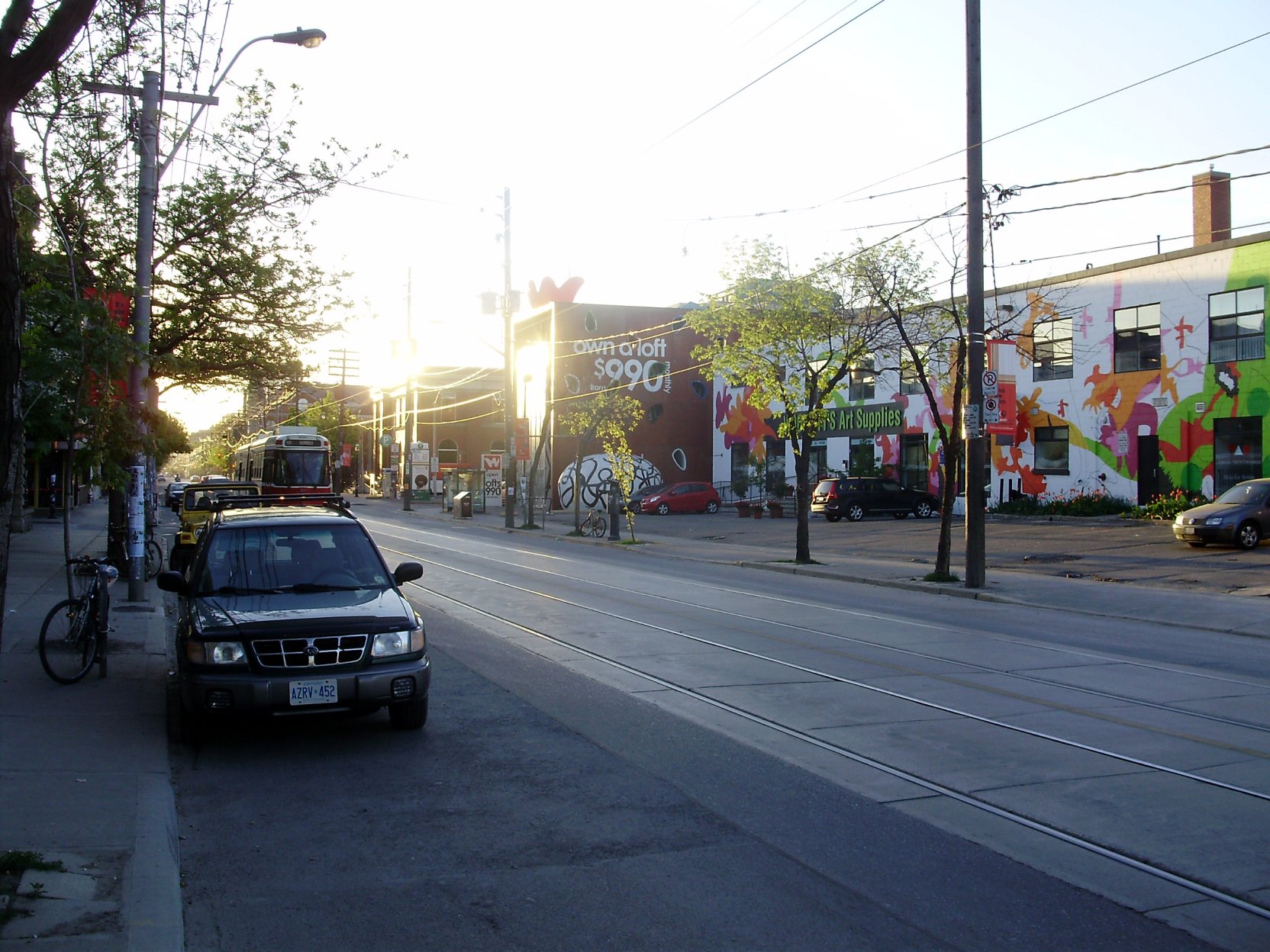
In the heart of Toronto, stretching an impressive 57.4 kilometers from south to north, lies Bathurst Street, a street that not only connects the city’s various neighborhoods, but is a living testament to the cultural diversity, immigration history and uniqueness of Canada’s capital city. Named after Henry Bathurst, the 3rd Earl of Bathurst, who never visited Canada, this thoroughfare has become home to numerous communities, quaint establishments and cultural centers making it one of the most unusual and interesting streets not only in Toronto but in all of Canada.
Geographical location and length
Bathurst Street begins at its intersection with Queens Quay, just north of the shore of Lake Ontario, and continues across Toronto to the city limits at Steeles Avenue. The street then extends beyond the city limits into York Region, where it is designated as York Regional Road 38, and ends at Holland Marsh.
Throughout its length, Bathurst Street crosses many significant arterials in the City, including Lake Shore Boulevard, King Street, Queen Street, Dundas Street, Bloor Street, St. Clair Avenue, Eglinton Avenue, Lawrence Avenue, Highway 401, Sheppard Avenue, Finch Avenue, and Steeles Avenue. The street is a four-lane thoroughfare for its entire length within Toronto, and widens to six lanes in some sections after Steeles Avenue.

Historical significance
The history of Bathurst Street begins long before modern development. Originally, this street existed only between Government Wharf and Queen Street, and the section to the north was called Crookshank’s Lane, a semi-private road named in honor of George Crookshank. At the junction with Davenport was the location of the No. 3 toll booth. The toll collector’s cottage, built in 1835, survives today and is located at the northwest corner of this intersection, restored to its original form.
Crookshank’s Lane was renamed “Bathurst Street” in 1870. North of Bloor Street, Bathurst Street remained a dirt path for a long time. This street gradually developed with the city, becoming one of its main arteries.
Interestingly, until the late 1980s, the section of Bathurst Street between Centre Street and Langstaff Road / York Regional Road 7 (formerly Highway 7) was part of Highway 7, which made a bend between the concession roads. This bend along Bathurst was eliminated when a diagonal connector road was built to the west to combine the two sections of highway into a single road.

Bathurst Street Cultural Mosaic
Jewish heritage
One of the most significant cultural features of Bathurst Street is its role in Toronto’s Jewish community. For decades, the street has been considered the heart of the city’s Jewish community. It has even been called the “longest Jewish neighborhood” in the Diaspora, as virtually all of Toronto’s Jewish communities are concentrated along this street.
From the early 20th century, many Jews lived around Bathurst Street south of Bloor Street, east to Spadina Avenue (especially in the Kensington Market area) and west to Christie Pits. After World War II, as the community became more affluent, it moved north along Bathurst Street. Wealthier members of the community moved to Forest Hill, while others settled near the intersection of Bathurst and St. Clair Avenue or Bathurst and Eglinton Avenue.
Currently, a significant portion of the Jewish community resides along the street from north of St. Clair Avenue and, in higher concentrations, south of Lawrence Avenue to the city limits at Steeles Avenue and beyond to approximately Elgin Mills Road in Richmond Hill. Bathurst Street is home to many synagogues and other Jewish community institutions.

“Blackhurst”: African and Caribbean heritage
Few people know that for over 150 years, the Bloor and Bathurst neighborhood was a center for black immigrants who not only lived here, but also created successful businesses. This aspect of the street’s history is often overshadowed by more famous landmarks.
The neighborhood has been given the unofficial name “Blackhurst” due to its importance to the black community. One of the earliest settlers is believed to be a woman named Deborah Brown, who arrived in the 1860s. A former slave, she escaped from the United States via the Underground Railroad and lived in a house on Markham Street.
The neighborhood was also home to Contrast, a newspaper that called itself “the eyes, ears and voice of Canada’s black community.” Founded by Al Hamilton in 1969, the publication was the launching pad for many prominent black journalists and writers. Famous names such as Austin Clark, Jojo Cinto, Cecil Foster and Royson James have appeared in its pages.
Russian community
The northern section of Bathurst Street, north of Sheppard Avenue West, became one of the centers of Toronto’s Russian community. Many Russian Jewish immigrants began settling in apartment buildings in the area (especially around the Bathurst/Sheppard intersection and along Bathurst between Finch Avenue West and Steeles Avenue West) beginning in the early 1970s to gain easier access to services provided by the Jewish Immigrant Aid Society.
After the collapse of the Soviet Union, many Russian immigrants to Canada settled here. The York Centre electoral district, which includes Bathurst from Wilson Ave. to Steeles Ave. West, has the largest number of Russian-Canadian voters in Canada. Numerous Russian delis, restaurants, bookstores and clothing stores have earned the area the unofficial nickname “Little Moscow.”
Weird and Unusual Places on Bathurst Street
Weird Things Antique Shop
One of Toronto’s most unusual stores, Weird Things Antique Shop and Clubhouse, was located at 998 Bathurst Street, just south of Dupont. It was a small art gallery and store filled with odd objects and offbeat art. Although the store closed in August 2021, it was a prime example of the quirkiness of Bathurst Street.
The store’s founder, Jonathan Petersen, created the space in 2013 primarily as a place for artists who might not have been accepted in traditional art galleries. “It’s always been a community space first and foremost, and it was a place where artists could gather and share ideas and show work,” Petersen said.
918 Bathurst Center for Culture, Arts, Media and Education
918 Bathurst is a non-profit arts, culture, education and media center located in Toronto’s Annex district. The building, which was formerly a Buddhist temple, now includes a 200-seat theater, art gallery and flexible event spaces. The center offers a variety of arts and culture related programs and events.
Blackhurst Cultural Center
Blackhurst Cultural Centre, also known as The People’s Residence, is a not-for-profit center offering experiences that celebrate the rich culture of African-Canadians and Canadians of Caribbean descent. The Centre works to preserve and promote the cultural heritage of the Black community in the Bathurst and Bloor area.
Architectural Landmarks
Bathurst Street is home to many interesting architectural landmarks including:
- Sir Isaac Brock Bridge – connects the section south of Fort York to the section north of the railroad tracks. The bridge was moved here in 1916 after being used as a railroad bridge over the Humber River.
- Thetoll collector’s cottage is a historic site indicative of the early history of the road.
- St. Peter’s Church – The Catholic Church, located across from Bathurst tube station, is a prominent landmark on the street.
- Honest Ed’s – for many years the most prominent landmark on Bathurst Street was the now demolished Honest Ed’s department store located at the junction with Bloor Street.

Transportation importance
Bathurst Street plays an important role in Toronto’s transportation system. Bathurst Station is a Toronto subway station at the intersection of Bathurst Street and Bloor Street on the Bloor-Danforth Line 2. The 511 Bathurst streetcar route runs from Bloor to Fleet Street, where it turns to connect to Exhibition Place.
North of Bathurst Station, public transit is represented by two bus routes: the 7 Bathurst route from Bathurst Station to Steeles Avenue West and the 160 Bathurst North from Wilson Avenue to New Westminster Drive and Atkinson Avenue in Vaughan. On nights when the subway is closed, the 307 Bathurst Blue Night bus route covers the entire length of Bathurst within the City of Toronto.
In the Vaughan area, York Region Transit serves several routes along Bathurst Street, including the 88 Bathurst from Finch Bus Terminal to Seneca College King Campus, part of Viva Orange, and other connections at Promenade Terminal.
Challenges and prospects
Bathurst Street, despite its historical and cultural significance, faces a number of challenges. For many years, it was in the top 10 of the Canadian Automobile Association’s “Ontario’s Worst Roads” survey every year from 2004 to 2007.
There are currently active discussions taking place about the future of the street. The Bathurst Complete Street project includes road repairs along with proposed changes such as new off-road multi-use trails, bike lanes next to the sidewalk and other improvements.
The RapidTO: Bathurst Street program addresses traffic problems on the street. Statistics show that it takes 75 percent longer to travel on Bathurst Street by public transit than by car. Only 63 percent of buses and 79 percent of streetcars arrive on time.
Author Information

I’m a journalist specializing in urban issues and city politics in the Vancouver region, which I’ve covered since 1994, and I also have a strong focus on the iGaming industry. In this endlessly changing city, I cover a broad range of issues: from drug policy, bike lanes, billion-dollar development projects, homelessness, and garbage debates, to the rapidly evolving world of online gaming, including regulatory landscapes, technological advancements, and market trends. I write frequently for the Globe and Mail’s B.C. section and Report on Business. From 2008 to 2015, I had a regular column in Vancouver magazine, “Urban Fix,” which apparently resonated with readers so much that it earned me a few regional and national awards.